Monday, 30 September 2019

1d6 Strange Arrows

Magic arrows are an easy way to give fighter-type characters cool abilities that resemble spells and vary their "utility" options. Here are 1d6 one-use ideas:

1. The intricate stone head of this arrow is fluted and curved, with small holes throughout. When fired it makes a continuous noise upon impact until it is removed. Loud enough to be heard for some distance, and to deafen anyone too close.
2. An arrow made of wood and bone. Being struck by it causes its target to follow a one-word command from the archer to the best of their ability. This magic does not compel living things. 
3. A purplish metal arrow that seems unnaturally strong for its frailty. The target of this arrow feels no pain, instead receiving a message from the archer's mind - words, images, and thoughts conveyed in a flash.
4. Tipped with obsidian, the shaft of this arrow grows into a copy of the arm that fired it once it hits its target. The arm mimics the archer's own in its movements, and disappears if it is injured.
5. A slight, slender golden arrow. Refuses to hit or damage any living thing, but will always strike true if aimed at anything else the archer can see. 
6. This arrow's stone head is bulbous and heavy, yet it flies well. Upon firing, the archer sees through the arrowhead's carved eyes instead of their own, until the arrow is broken or retrieved. 

Wednesday, 11 September 2019

It Came From The Blogosphere! In 4D!

Every once in a when-I-feel-like-it, I gather up the posts and related RPG ephemera I've been enjoying lately, a fresh punnet of gaming berries for you to pick through like a hungry songthrush, snuck into the grocer's stores whole her back is turned.

Buckle up jabronis, we've a bumper crop this time around!

welcome to internet
First off - the Ennies are tabletop RPGs' (second) biggest award show, and some good games got accolades this year, including Mothership winning gold for Best Game! Of course the real awards season highlight was the Rammies... Check out Ramanan Sivaranjan's personal picks here to see who deserves your pocket money.

High Priestess of the OSR Emmy Allen has a system for creating magic items which, with its focus on seasons, feels very much like something I'd have written and thusly should fit snugly into your game if you use things from this blog like the weather generator or my Witch's List adventure. She's also posted about her brilliantly conceived cult-ridden town generator, as well as a very cogent argument for the use of "diegesis" and its related film theory terms as useful categories when discussing mechanics in RPGs. Read that right here if you want some good theory.

Artpunk maven Patrick Stuart asks whether gnomes can be interesting, and then deftly weaves folklore, game lore and his own inimitable ideas together to prove that... Yes. Yes, they can. I love gnomes now.

Dan occasionally blesses us Throne of Salt readers with a splurge off odds and ends, unfinished ideas and stray concepts that are a ripe boneyard for any graverobbing GMs in need of inspiration for their next Frankenstinian creation. This is post no. 4 in his notebook series, and there are some true gems in there.

Where would we be without Goblin Punch? Nowhere fun, that's for sure. Here's some theory on "dynamism" in games, a truly terrific location for adventures with a Damn Good Gimmick in the Lost City of Nibulum, and an encounter roll system so good I want to base a whole game around it. Oh, and here's a class called the Baboonist.

Speaking of cool classes, here's Ben "Questing Beast" Milton with the Skeleton King for his upcoming Maze Knights game.

Skerples has gifted us with 1d50 missions for medieval mercenaries, including some of the best quest hooks I've ever read.

I've not come across this blog before but these consumable magic items from Pathika certainly won me over - as did the Dungeon Meshi image used in the post.

Chris McDowall has some good things to say about the importance of information and how to use it when running RPGs. I really like "impact" over "consequences" as a descriptor for what player actions cause within the game world.

Prepare for your eyes to turn into covetous anime sparkles - here's a preview of something the BREAK!! team is working on that looks straight up gorgeous. Check it out!

The Alexandrian is legendary among RPG blogs, and I'm sure you don't need me to get you to give it a read - even so, let me implore you to check out this hugely well-informed post on why system... Matters?

And here's Bryce Lynch with a metric fuckton of adventure writing advice tucked into a box the size of a small blog post.

And if all this RPG advice is a bit much, Daniel Sell has words of wisdom for dealing with writing advice as you make your own RPG things.

For those of us who brave the stormy seas of Twitter to discuss RPGs (hit me up! @CustardFaceKid), it's easy to be overwhelmed or sucked into some really toxic discussions. Sean McCoy has made a thoroughly good-hearted and helpful guide to getting better at using Twitter to talk positively about the things we love.


Now then...

Let's get historical, shall we?

Starting a couple of whole-ass centuries ago! Here's Joseph Manola talking about how Walter Scott was a big nerd who basically could've invented D&D if he wasn't so busy writing poems. Seriously. Give it a read. And while you're over at Against the Wicked City, have a gander at these (actual genuine!) urban superstitions from the 1800s, free to repurpose into terrifying realities for your game.

And now to the history of our hobby itself. As a hot-headed Gen Z grognard barely emerged from my chrysalis, I'm always fascinated to learn more and hear new perspectives on the history of tabletop RPGs. For instance...

Could it be said that the British old school is a different enough strand from the American to warrant its own OSR? Here's the Uncaring Cosmos making a case for just that.

Cecilia D'Anastasio has written a stunning report on a legend most old hats probably know like scripture, and the question behind who really "invented" D&D and the modern role-playing industry... Dive into Blackmoor, and the first ever game of what would be Dungeons and Dragons.

And finally, a glimpse into a brief, shining moment in recent history, and a highlight of play-by-post gaming, as Japan worked wonders with the concept of postcard RPGs. I'm so enamoured with this whole thing that I might have to find some way to do it myself...

In any case, that's all for now! Happy reading, and remember - there's always good stuff on the blogs.

(Got a favourite post from this edition of ICFTB!? Leave a comment on that person's post, letting them know how much you liked it!)

Saturday, 31 August 2019

The Fields of Calliope

In th' fields of Calliope
Life's but a dream
There are a great many

Sights to be Seen!

O! th' fields of Calliope
Fiddle-di-dee!
Just make sure you're back home
In time for your tea!


Here's some extra bits you can use with my demiplane setting Calliope, or just put in your game however.

Landmarks
1: Farm
2: Farmhouse
3: Tree
4: Hill
5: Water
6: Oddity

Farm
1:
A scarecrow asks you to carry him to see his love, who is in another field. The farmer will berate you for taking the scarecrow, if he spots you.
2: Full of cows. They can predict the weather.
3: A tall crop of wheat, infested with light-fingered imps. Somewhere deep within, a rabbit is having a tea party - his tea cures madness.
4: An orchard of hat-bearing trees. One could start a new fashion by crossbreeding a top with a bowler. The farmer laments - she only wished to grow apples.
5: Towering piles of large brass needles, bundled together like hay. A scarecrow in the next field sold a piece of her straw to the porcelain witch who lives there, and wants it back.
6: As the old song goes: This scarecrow is laden with magpies and ravens/ they don't find him scary at all. Perhaps you could teach him new tricks, or find him some more frightening attire?

Farmhouse
1: The farmer is impressed by adventurers, and wants to marry off her three sons. They are pretty useless, but she is a weather-witch who dotes on any new family.
2: A dozen pigs have broken into the farmer's house while he is away, and made a mess of the place with their revelry. If you help them clean up and replace a broken gravy boat before dinnertime tomorrow, they will give you a gold coin which always lands on its edge.
3: A witch lives here, but doesn't seem to be home...
4: Little mice work the mill and kitchen, baking fresh bread. They want to start delivering to the castle town, but need a non-mouse liaison to set up a route via which they can carry their bread undisturbed and leave it on the baker's table each morning.
5: A sunflower has sprung up through the floorboards and burst out of the roof! By day he is too busy soaking up the sun to hear reason - uproot him carefully by night and find a better spot to plant him so that the farmer can have their home back.
6: This farmer despairs, as his turnips uproot themselves and escape every night. Find a reliable way to keep them contained, and he'll teach you how to sing a campfire into life.

Tree
1:
This tree's branches are laden with ripe crab-apples. Three friends argue beneath the boughs - a cat who wants to make jelly with them, a dog who wants to eat them whole, and a donkey who will offer his labour to anyone who can make his friends stop fighting.
2: In a nest at the top of this tree sits a taunting magpie. She is an able thief, but will only steal something if the payment for her services is an even more valuable treasure.
3: By night, the branches grows delicious white apples that shine like the moon. By day, the apples disappear.
4: The Come-Around Tree. Sticks taken from it will, given half chance, fly back and reattach themselves to its branches. Children play at snapping off twigs, wrestling them to the ground and then letting them go - the more adventurous ones try to ride whole branches as if thy were a witch's broom.
5: This tree is lost, and wants to go back to his spot in the forest. Moving a whole oak may prove difficult.
6: Home to squirrels who desperately want to see a play. They can offer nuts aplenty in exchange for tickets and an escort, along with their fiercest warrior as an ally.

Hill
1:
A standing stone atop this hill is a meeting-place for young children who play an elaborate game. They have found a magical sword, but will not give it up lightly.
2: A young couple sits on a blanket, picknicking. Nearby are some bumblebees, plotting to steal their jam. Pick a side - the couple will offer a slice of pork pie with healing properties in exchange for dismissing the bees, while the bees are good to have on your side in a heist.
3: At the weathered peak of this hill is a gravestone, haunted by the melancholy spirit of the man buried there. He cannot pass on until he remembers the smell of a freshly baked blackberry pie.
4: Large woodlice roll down the slope for fun, but would like an easier way to get back up again once they reach the bottom. Solve their problem and they'll gladly join you on your next quest.
5: This hill is in fact a giant, recently woken, who wants to roll over and go back to sleep. The trouble is he had been sleeping for so long that fairies have made homes in the mushrooms that had grown from his belly button. Find them a new home, so that he doesn't crush them. The fairies like any house that is far prettier than its surroundings.
6: Atop this hill is an anchor and chain, mooring a little flying boat hidden by cloud. The captain wants to stock up on cheese before his next flight, and will pay in stories of an imminent visitor From Foreign Lands.

Water
1:
A nymph in a pool wants to wed the most eligible member of your party. They would live out the rest of their life beneath the surface, but their child would inherit their wealth and possessions, as well as some of the nymph's power, and be free to roam.
2: A bridge, guarded by a dimwitted troll. Some goats want to cross over, but risk being eaten - they offer their strongest son as a mount should you help them.
3: By the shore of a lake sits a painter with an easel and brush. They will offer their walking footstool in exchange for paints - anything that leaves a stain is good enough, in three different colours please.
4: A puddle has formed in a large footprint. A frog wants to live there, but her wife is worried that whatever giant made it may stomp this way again. If she could only meet a person or creature that big, she might be calmed to know that not all giants are horrible and settle into this new home. As a reward, the frogs offer the secret of a kiss that, with true love, turns royalty into one of their kin and back again.
5: There is a little house that only exists in the reflection of this pond. By aligning one's own reflection just right and miming a knock on the door (or through some similar scheme), one can call the occupant to the door, who will appreciate the visit and teach a spell that tricks mirrors into ignoring you.
6: Frog-men race lilypads down this creek. A fine oar or sail is of great use to them, or even yet a wild duck, captured and tied down. They can tame any waterfowl into obeying a single, one-word command from its owner.

Oddity
1:
A really big egg.
2: A great fish, fallen from the sky. Take them to the highest point you can and they can catch a breeze back home - they'll pay in a shower of sparkling scales.
3: It is this young ostrich's dream to be trained as a knightly mount within the castle town, but he's far too cowardly. If you can help him overcome his fear, you'll have a friend for life within the castle guard.
4: A mole has sprung up to complain about the noise above - there isn't enough of it! Make some music or find a band to play for him, with at least three musicians to ensure a sufficient volume, and he'll let you use his tunnel into the castle town.
5: A little dragon who delights in causing mischief by turning things it touches invisible. Keep it contained so it can't do any more harm! Once it matures a little it'll see the error of its ways, given the proper guidance.
6: Some squirrels have constructed a man-sized mechanical effigy of the late prince. They plan to con the king out of all his acorns - oh, and money. The old coot is just barmy enough to fall for their ruse, but despite their confidence anyone else will see at a glance that this is not a man at all, but several squirrels operating a series of pulleys. The only solution is to get the squirrels, with their contraption, to the king, alone...


Wednesday, 28 August 2019

a "REACH" fangame - brainstorm

I did something like this once before.

Basically, if an artist I like posts something cool, and I think it would work great as a premise for a game, and I'm inspired enough that my game design notions turn into game design notes, I do a "fanart" game. I can't draw, so this is my way of engaging with that inspiration and creating something.

This time, my thoughts are still v fresh, so you're getting my raw notes/brainstorming. I wondered whether this would be worth a post - last time I posted a finished game, and even when I designed a game from scratch on this blog I'd already done the brainstorming work and got basically right into mechanics.

But i think demystifying the process is good! A while ago I watched Adam Koebel livestream himself designing an RPG from scratch and it was heartening to see that a Professional Game Designer's first draft was a word document of random notes, same as mine. Now that I'm kind of a Professional Game Designer myself, maybe someone will find these notes useful too.

by Jack McGee

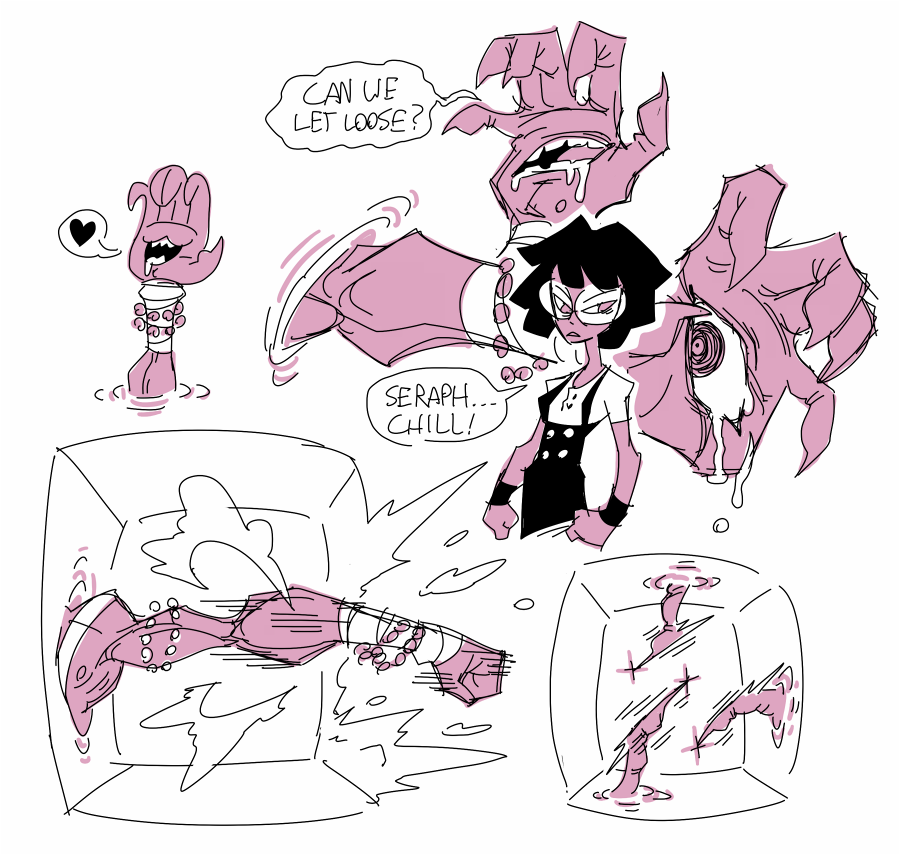
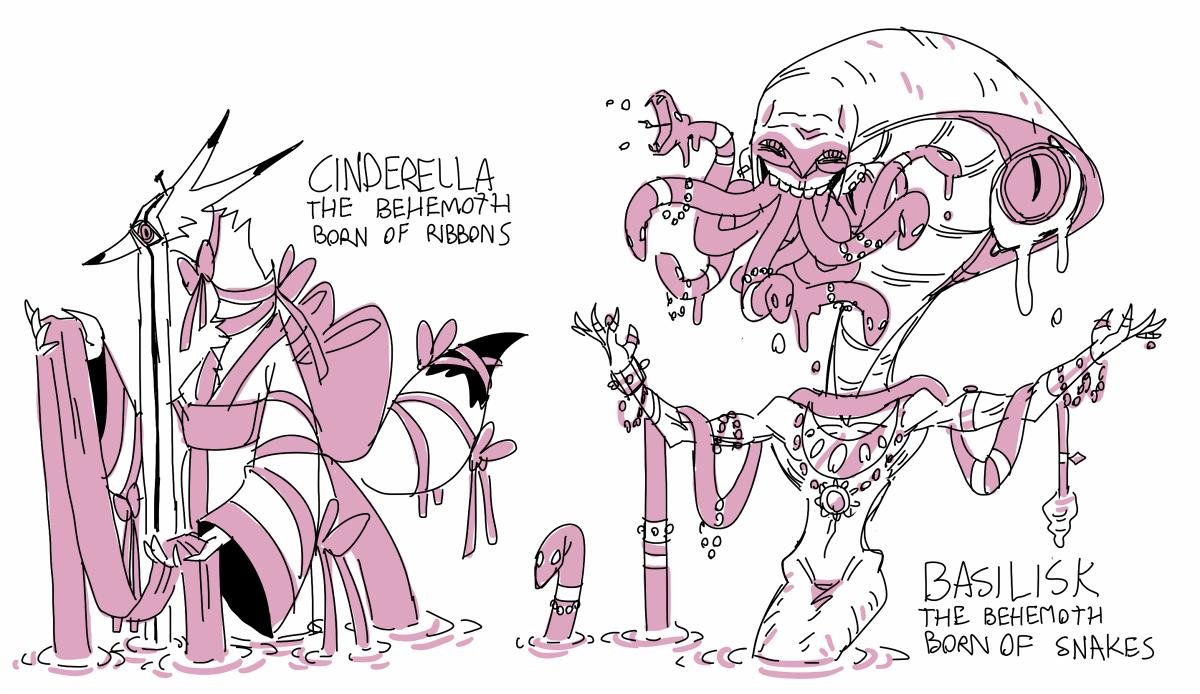
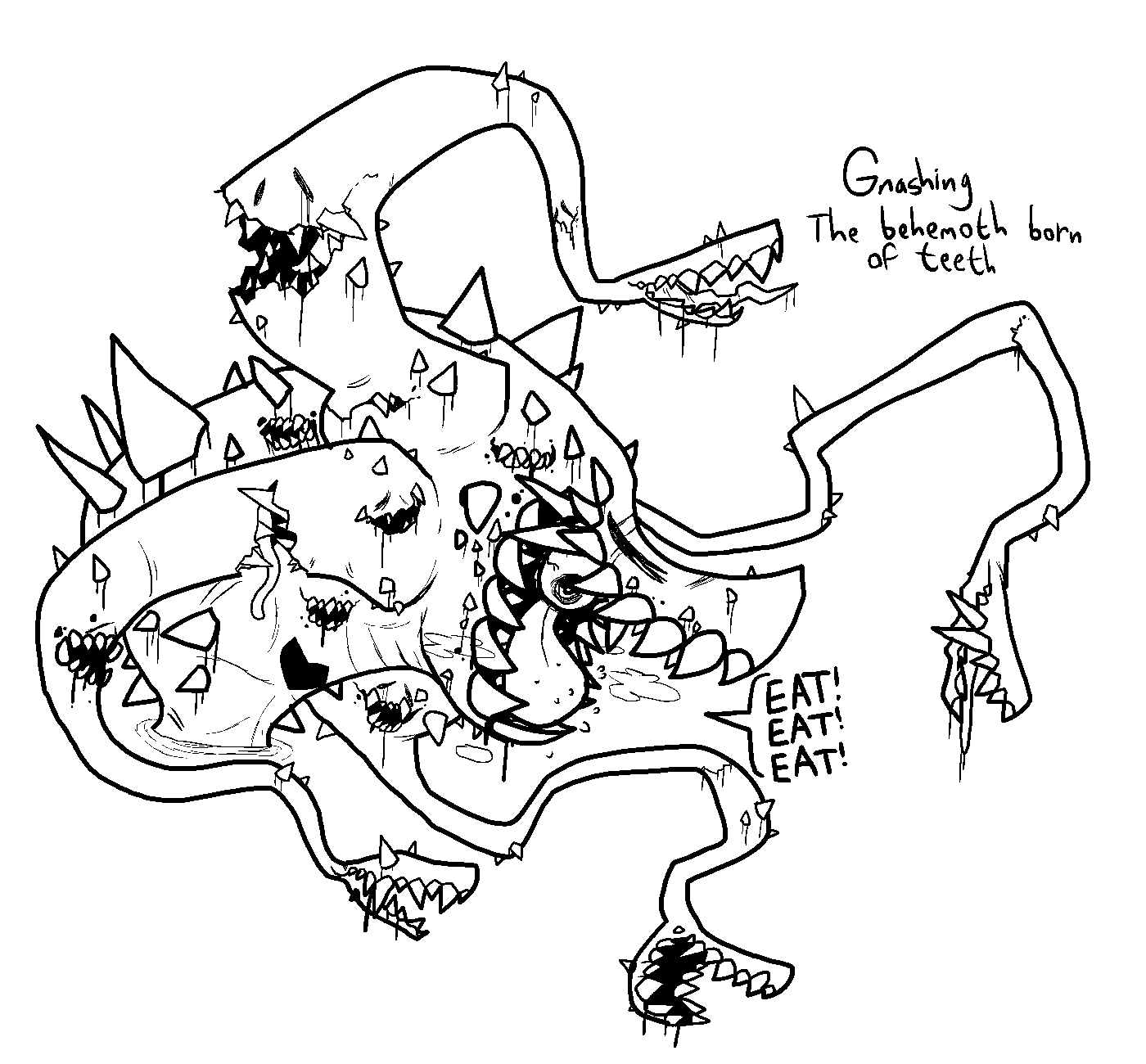
This time round, my inspiration is this badass concept by Jack McGee (@Drooling_Demon on Twitter). Eldritch horrors from a dimension beyond our own latch onto hosts who use them for cool fights, summoning parts of their Behemoth through surfaces like walls and floors. The different body parts and abilities each Behemoth has influences their partner's fighting style, and the partner also gains some aspect of the Behemoth's power permanently.

I suggested a name for the thing on twitter: REACH

Yes, it's very cool and very anime. You should check out Jack's webcomic Star Impact too, it's awesome.

My initial idea for a tabletop RPG wasn't one I could make work. Reliance on 3D space isn't something tabletop games do especially well, at least not to the relatively granular degree I think this concept necessitates, and certainly not through theatre of the mind which is the realm of spatial abstraction I generally prefer designing in. Video games do "space" really well, but I, uh, can't do computer.

The tabletop idea that stuck with me though, was a card game.

look how cool!
you should for sure check out more of their stuff on Twitter! 
TCGs are prohibitively expensive, so it'd be a self-contained thing. 1v1 competitive play, with each player using a character card and a corresponding Behemoth deck.

The character card remains out at all times. I'm taking a lot of inspiration from Yu-Gi-Oh (which btw is very D&D and has great monsters for your games). I feel like the battle shonen vibe is appropriate here. The character cards face off, with a certain amount of HP, and attacks or abilities they can use on each player's turn. First player to defeat their opponent wins.

Meanwhile, each player is drawing cards from their deck to summon Behemoth cards and play them in (5? 3?) spaces in front of their character. These spaces are that abstraction of physical space we were after - there would be just enough that the board feels a little cramped.

Might do it like Yu-Gi-Oh, where you can't directly attack the opponent (in this case their character) without clearing the field of obstacles or using an ability to do "piercing" damage.

These cards represent aspects of their Behemoth (Eye of Beholder, Left Arm of Seraph, etc.) and have effects - bonus to attack; this card attacks on its own; disable enemy effects; get more cards... Other things that augment their character's specific abilities. There are decades of TCG mechanics to draw on here. Behemoth cards would all have their own HP, and can be targeted for attacks and destroyed.

Then, another mechanic taken from Yu-Gi-Oh, but also used in things like Pokemon. You can play weaker Behemoth cards straight from your hand, then remove them from play to swap in a stronger card from your deck (or a sub-deck, to prevent dead draws). Two Eyes of Beholder are worth a Beholder's Maw, or three for a Beholder's Many Eyes. Bigger cards with better effects.

Or: Can you open up more spaces? And maybe better cards take up more spaces? That's a better literal reflection of the premise, but I'm not sure it's a better game mechanic.

Here is cool-ass fanart of an original Behemoth by Dragon Princess Green on Twitter.
Anyways.

I'd keep things slow, with relatively small numbers. A strategic, thinky game, working on getting your own engine up and running while making sacrifices and setting traps for your opponent as they try to clear vital parts of your game plan off the board.

For more variance, and to bring in more of the concept of physical space, there could be a third, "neutral" deck representing the fields of battle. "Downtown City" cards, or "Ancient Labyrinth". The place our characters are fighting in. A roster would be drawn into the middle of the field, and players could take cards from it as opposed to their deck in order to change up their strategy based on the various benefits the terrain might offer them.

(Not sure about that bit. Seems like a lot of work. Would make battles more thematic and cool tho... Each game with a new combination of opponents and location would be like a new episode of an anime.)

... Anyway, those are my thoughts so far!

This would require a lot of balancing and work, so if I do any more with it it'll just be now and then in my spare time.

In any case it feels good to just do a full-on rambling, idea-splurge post again.

Monday, 26 August 2019

Ice and Steam (a 5e Encounter)

Haven't shared much of my current 5e campaign's content, mainly because my notes consist of random scribblings and d6 tables written on the way to each session. That's about as much as I prep these days.

Last session though, I had occasion to design an Actual Tactical Combat Encounter. Grid map and everything! Again, just something I made up on the fly an hour before the game started, but I like it and I reckon there are bits here you lovely folk might be able to steal.

References to my campaign's setting are for my own amusement, you may obviously adapt them to your liking


Ice and Steam - a 5e Encounter for characters of roughly Level 3

The players can enter the cave from the south on their way through the Ice Path. It would provide a good shelter from bandits or a sudden blizzard, and if they are searching for something on this route then they will likely want to check it anyway.

Heck, they're D&D players. It's a cave. They'll want to go in.

forgive the scribbles, and the photography. i am a Writer
The snowdrift comes into the cave entrance a few feet, then stops. The inside is still bitter cold (creatures not used to cold or dressed appropriately* must save vs exhaustion every hour in this weather). A rocky outcropping part-blocks the path before the cavern opens up.

The ceiling is about 10ft up and covered in icicles. The floor is frosty, except for under the red pipe that emerges from the cave wall, about 3ft off the ground, and continues to the far end, disappearing once more into the rock.

There are patches of ice (difficult terrain) on the floor (that's what those shaded bits are supposed to be).

The pipe is red not through paint or the type of metal, but the superheated steam within. (Travellers from Arcadia Pits will know this, having seen the pipe's origin in the second reservoir.) Contact with the pipe causes 2d4 fire damage per round. It's high enough off the ground that a gnome could walk under, but anyone taller would have to roll acrobatics to duck or roll as they move. There's also enough space above the pipe to move freely over it.

The two northern tunnels lead to eisengor nests. The left one has a further hole at the back that leads up and out of the cave.

The big tunnel opening to the left is an ice slide almost 100ft long that descends into a lower cavern Here is the frozen body of the man the party was tasked with finding, Nabokov.


Eisengor

Inside the main cave are 1d4 eisengor. The rest are nesting in the top-left or top-right caverns, and will come if another eisengor flees to fetch them. (Total no. of monsters is whatever you deem appropriate to the number of party members - I went with 4 apiece which was challenging but very doable.)

Picture the monsters from Attack the Block, but reverse the colours (white fur, black teeth), and scale them up by like 3 times. Big ol' yeti-gorilla boys. Their arms are longer and more muscular than their short legs, and their hands are huge, padded and clawed, with opposable thumbs. They know the pipe is hot and are smart enough to avoid it.

Medium creature
Alignment: is an artefact of a single D&D campaign and has no inherent bearing on the modern game
AC 14, HP 32, Movement 50ft
High Str, decent Wis - use Lion stats from the PHB if you need them for saves etc
CR: is nonsense
XP: not today, Satan

Attacks
Claw: +5 to hit,  melee, 1d6+3 damage
Bite: +5 to hit, melee, 1d8+3 damage
Icicle Throw: +3 to hit, 15ft range, 1d10 damage, DC 13 dex save vs being knocked prone.

Abilities
Multiattack: 2 attacks on its turn
Charge: If an eisengor uses at least 20ft of movement and then attacks, the target makes a DC 13 Strength save on a hit. If they fail they are knocked prone.
Savage: may use a free action to make a Bite attack against a prone enemy once per turn
Grasping Claws: If an eisengor makes two claw attacks against the same target in a turn and they both hit, the target must make a DC 13 Strength save or become restrained. While an eisengor has a target restrained it cannot use its claw attacks, but all Bite attacks are instant criticals and deal d10 damage
Ice Climber: An eisengor can use icicles or other cave features to hang and swing, monkey-like. They ignore terrain and obstacles below them while swinging. (As long as they are about 10ft up or less they're still in melee range because they're so big, but the space right under them is considered usable by other creatures if it's empty.)


*appropriate dress varies... the ogres up-mountain seem to be content with scraps of fur, while if a human came here without a dose of sun oil they'd freeze in an instant. The wrestler Icarus Armageddon, known to his friends as Odeir, doesn't seem to feel the cold either...

Friday, 2 August 2019

Bell Peppers and Beef

I like how money works in RPGs - as in, it just kinda does. You start poor and then do missions and get a bit richer - now you can buy better gear to do more missions! You get to see those numbers go up, and with them your characters' social standing and potential to get cool stuff.

It's like real life capitalism, except you don't have to worry about millions of people and the planet they live on being systemically crushed by the relentless pursuit of a few chosen individuals' personal gain! Huzzah! Money is one of those things, like conversation, that you don't really need to abstract through mechanics in a tabletop game because you can just play out the real thing at the table, or else handwave it as needed.

But for the new 5e game I'm starting with some friends, tallying gold and copper just didn't seem ideal. It wouldn't fit the tone, for a few fairly arbitrary reasons, the biggest one being that this campaign takes inspiration from Cowboy Bebop. 

(I almost launched into a Cowboy Bebop treatise here, so this little aside is me barely managing to stop myself from ranting about one of the greatest TV series - not just in sci fi or animation, but of any medium or genre - of all time. If you've never watched Bebop... Watch Bebop. Just... Just watch it.)


I figured our heroes in this setting weren't the classic B/X gold-for-XP murder hobos, as much as I love that conceit. Nor were they 5e's archetypical fantasy rag-tag do-gooders who maybe buy a boat. These are people under constant systemic and societal pressure, worn down by a world that works against them at every turn, struggling to survive through loopholes and dirty tricks - drifters in a cosmic race that threatens to overturn their unstable lives of they ever, for even a second, stop running. They won't ever get rich, and if they do they'll die trying.

Also I thought it would be cool to have scenes of them sipping coffee in a hazy neon jazz club or eating ramen from a street stall between jobs, and I didn't want to undercut that with "ok, everyone cross off 2 copper". Money is a background feature in this world, a system first and a tangible gameable thing a distant second.

But at the same time, this isn't a storygame, and spending power means something to the way players approach challenges. I want to give them the satisfaction of earning something from a job (on top of the best thing to earn from adventures which is fictional positioning, and the second best which is levels and items and stuff), even if it's quickly ripped away again. Money and how it relates to the characters' place in this world is interesting and gameable, and I want it to have weight. I also wanna reinforce the "just one more job" cycle of play that RPGs excel at anyway.

So, I cooked up a little something with what I had and ran it by my players. They agreed it was a good idea - a session in and it's working nicely so far.


Here's my Bell Peppers and Beef (and hold the beef) Financial Abstraction Mechanic. Or as I half-jokingly call it, the Poverty Roll. Kind of a variant on "usage die" mechanics.

The crew has a shared Money stat of 1-20, most likely starting at a 0 or 1 given the implied flavour. Gritter games can use a lower top end to the scale; 1-10, or 8 even.

Each completed mission earns the players 1, 2, or occasionally even 3 points depending on the fiction.

Every time the players:
- spend a day shopping or the night at an inn. Y'know, an in-game day where they make general, normal purchases
- make a significant purchase (relatively speaking, I'm thinking like a magic sword or a big bribe) or otherwise spend more than usual for the day
- take a long rest (1 week in this setting as per the 5e DMG's variant rule)
- other relevant expenditure as decided by the GM

They roll a die, dX, where X is the highest integer that is lower than their current Money stat and is also a die type available at the table - or a d4 if the stat is 1-3. (d2 also possible I guess.)

On a 1, they lose 1 from their Money stat.

At 0 Money, they have no purchasing power and must take a job before they can buy anything.

Try it out! Try not to think too hard about how it mirrors real life financial struggle and the world is a cyberpunk hellscape ✌️

Tuesday, 9 July 2019

Games Worth Playing: Kobayakawa

A word of warning: this post discusses a gambling game, and the act of gambling, in a favourable light. As with everything I write, I trust you to know whether or not a game I recommend is appropriate for you and the people you play with. Be good to yourselves.

Also: If you're unfamiliar with Games Worth Playing, start here!

Kobayakawa


Designed by Jun Sasaki, published by Oink Games (and Iello). 3-6 players, 20~ minutes, ages 8+. Game is language-independent, version reviewed includes English and Japanese language rules.


Little Box, Big Oink


Japanese indie publisher Oink makes cosy little games in appropriately cosy little shapes. Every game they put out is tucked snugly into an 11 x 3.5cm box (!), and while there's nothing whatsoever mechanically linking their wide variety of titles, all those diddy Oink boxes share a certain spirit.


From Tomatomato, a kid-appropriate tongue-twister generator, to Startups, a personal favourite that combines set collection and bluffing for a tense and involved competitive challenge, an Oink box tends to be a tight, controlled play experience focused around one or two simple, easily explained mechanics. Because of this simplicity they're generally pretty accessible; you can almost think of Oink games as being the Boardgame Renaissance's take on old family classics - but these are classics with a twist.


photo by BoardGameGeek user bortmonkey
Games are Deep Sea Adventure, In A Grove and A Fake Artist Goes To New York.

Fun fact: Deep Sea Adventure lists "Goro Sasaki" as a designer. That's Jun's 6-year-old son! He came up with the idea of a game about getting treasure beneath the ocean, and his dad gave him a co-designer credit.
This "with a twist" tagline is a little reductive given the breadth of originality present in Sasaki and his fellow designers' work, but let's roll with it for a moment. Maskmen, f'rinstance, is a lot like party classic UNO, the "twist" being that the rules governing how cards can be played emerge during play itself. It makes sense in context, trust me - and is both a decent party game for groups and a nice little contest at 2 players. (UNO, btw? Very popular in Japan. Last time my mum was there she sent me a picture of UNO sets in a vending machine.)

How's this for "with a twist" -  A Fake Artist Goes To New York, perhaps Oink's biggest release in terms of acknowledgement if not box size, is essentially reverse Pictionary, but with a hugely entertaining hidden role element - someone doesn't know what we're all meant to be drawing! Or yet another game, Insider (recently caught up in some unfortunate controversy as suspiciously similar game Werewords receives recognition and awards nominations while Oink's version remains under the radar) which infuses folk game 20 Questions with a similar degree of paranoiac fun, likewise through a hidden role.

It's perhaps overly clear at this point just how enamoured I am with Oink's output. The streamlined focus on play experience, the simple yet fresh mechanics that hit the spot far more often than they miss... those lil boxes! The way they make rules explanation videos by turning the game boxes into a stop-motion pig. Oink have been facilitating great board game nights of mine for a short while now, ever since I found out about them, immediately became a fan and ordered a slightly unreasonable number of titles direct from their Japanese HQ (with free worldwide shipping! Don't get carried away, and remember to check customs charges for your country). I'm currently refreshing that store page every other day, waiting for their newest release Nine Tiles Panic to go on sale.

The box in question - Kobayakawa.
The Clink Of Coin

Now that I've gushed all over you about the people behind this little doodad, let's actually have a look inside the box in question, shall we? Board games often live or die by the attention designers pay to the actual, physical bones of them - so how does this little blue box shape up as a physical artefact?

Kobayakawa (the name of a Japanese feudal clan, from whose crest the game also takes its logo) is, to put it mildly, light on components. The main component is a very svelte deck of cards numbered 1-15. Yup, that's just 15 cards. Along with some tokens, that's the whole game.

These slim pickings attempt to justify a not-inconsiderable price tag through build quality. Those few cards are weighty, with a tactile protective finish and smart, minimalist design. And the tokens are metal, a full 70 of them in a little drawstring pouch of sturdy fabric, the handling of which makes you feel like a medieval tradesperson (side note - a good prop for your RPGs?).

I'm of the opinion that a great game is more than just the sum of its fancy knick-knacks, and I've had the time of my life with more patchwork indie games and makeshift playtest components than I can count - but dang if those hefty tokens don't feel nice. Upon opening the box, I passed the little drawstring bag round the table just so my friends could have a hold of it. More than one "ooh" was uttered.

I personally feel the extra care put into the game's aesthetic is worth the coin, but Kobayakawa's price tag is undoubtedly its biggest sticking point. If you're understandably unsure about forking over $25 USD for a box of not-much, consider one of Oink's more component-heavy games. Tricks and the Phantom has custom coloured wood pieces, little cardboard magnifying glasses and cool noir-ish card art if you feel like a deduction game, and the aforementioned Startups packs a level of complexity that surpasses Oink's normal semi-casual fare into a package of the exact same size and price as Kobayakawa (all Oink games are sold at the same price point, though you can likely find the popular ones a bit cheaper at local game stores).

One more important thing to note with regards to the physical quality of the thing you're buying - Kobayakawa was licensed to the much bigger fish Iello Games for an international release a few years back, after an initial, smaller launch in Japan.

While Iello's version is likely available cheaper, I wouldn't recommend it - the art is adapted to be a bit more flashy, losing some of the cool simplicity of the Oink version. And perhaps the biggest drawback - those metal tokens that make our little box so wonderfully weighty? They're cardboard in the Iello version, and you only get half as many. Thankfully, Oink re-released their original version, with some updated rules, in 2019.

Let's look at those rules now, shall we?

(Side note - Iello also redesigned Oink's Dungeon of Mandom, a fun push-your-luck/bluffing game with a jokey dungeon-crawl theme, releasing it as Welcome to the Dungeon in Europe and the US. If you want to try it, get Oink's new edition Dungeon of Mandom XIII, which combines the original with extra content that Iello fobbed off as a full-price expansion.)

Daniel Craig as James Bond, playing cards - the example used in Shut Up and Sit Down's An Intro to Board Games as proof that board games can be cool. Point taken.
(Also, SUSD are lovely fellas who do sterling work, so check out all their reviews!)

Shaken, Not Stirred

I'll bring up that "with a twist" tagline one last time here because, again, while it's somewhat reductive, it does explain Oink's style in a neat little elevator pitch quite well - just the sort of pitch you might use to coax your friends and family into a quick game. (Tip when pitching Kobayakawa to your group - set it up under their noses even as you sell them on it. There's so little to organise that they'll be ready to play before they have a chance to say no - and a round takes mere minutes, so there's much less commitment than your average trial run.)

So then, we've revamped Pictionary and UNO. What's the game that Kobayakawa spruces up with that classic Oink twist? What's the folk favourite you'll be likening this to in a "like that, but good" way as you shuffle your barely-a-deck and pass out shiny coins to prospective patsies?

Poker.

That's the whole review right there, let's be honest. No sense beating around the bush with the whole spiel about cute little boxes and build quality: Kobayakawa is like poker, but good.

OK, that's unfair, poker is good. It's the one cool tabletop game, in fact - bucking the trend of the hobby's association with esoteric rules, poor personal hygiene choices and dingy basements by replacing those with slick casino bluffery, tuxedoes and cocktail dresses, and the bright lights of Monte Carlo or wherever the next Bond movie is going for location shoots.

Poker is cool. It just is. It's literally in the dictionary - someone in control of a situation is "holding all the cards", and if they can do that without letting on, we describe their effortlessly cool expression as a "poker face".

There's even a well-known (infamous?) variant of the game where people take their clothes off, and that's just kind of... accepted? I mean, strip poker's rules are questionable from a game design perspective, regardless of your personal moral position on competitive nudity, but the point is that poker's so cool we let it undress us - whereas I'd imagine that a game of "strip Magic the Gathering" might have less of a mystique.

The thing about poker, though, like most card games of its age: the rules aren't great. We don't care, because that's not really the point of poker. Rules are so rarely the whole of a game - we know this, being something of an OSR RPG blog. But the random hierarchy of decreasing possibilities associated with the various winning hands is the kind of thing you need a reference sheet for until you've played a dozen or more games.

Wouldn't it be great, then, if there was a game of poker that didn't have all those rules? If there was a poker-style game with... one rule?

There really aren't many different images I can use of this game. It's very slight.
One Rule To Bring Them All

Ok, more than one rule, but they're so simple that it's basically the same thing. The rules of Kobayakawa are so simple, in fact, that I will now explain the entire game to you in four sentences.

1. The dealer gives each player one card from the deck, and one more card is shown face up to all players in the middle of the table; this is the "Kobayakawa".

(Side note - I'm still not sure why the game is called what it is. There's nothing particularly notable about the clan themselves from my cursory glance at their history - it's my guess that Sasaki went with a classic, somewhat noble-sounding name to match the game's elegant simplicity and "timeless", parlour game quality. Or it could be a potent metaphor - who am I, Bill Wurtz?)

2. Each player in turn may choose to either take a new card - keeping only one of their two cards and discarding the other face up - or flip a new card from the deck onto the Kobayakawa to replace it.

You can tell how, with such a short and simple decision for each player to make on their turn, play progresses at a heck of a pace. Board games have recently been delving more and more into simultaneous play and other structures to avoid the classic problem of players sitting around waiting to do something, but in a game as whip-fast as Kobayakawa that's just not an issue.

3. Players bet on their hands in a system identical to poker*, before revealing their cards - the highest card wins.

*the old version of the game, from Oink's original run, had its own betting system, and I believe the Iello take included those rules too. You can look that version up online and give it a try, but I reckon the 2019 edition's use of the standard poker setup works wonders.

At this point, you're likely wondering where all the game is. There's nothing in the box, and those are the only rules? Have I really become such a consummate rambler (talking, not hiking, though I do enjoy a stroll - ok, not the point -) that I've written this bloody much about a game that... isn't?

It's at this point that I allow myself a small smirk, lean across the table, and reveal my hand. Because rule number four is the twist that makes this Oink box sing.

4. The player with the lowest card adds the current Kobayakawa to their result - if they are now the highest card, they win.

The game designers among you, of whom I'm fairly certain there are a none too insignificant number, are quite possibly now grinning and scrolling back up the page to find that Gumroad link so you can play this tiny thing for yourself and find out if the real thing is anywhere near as good as the wild possibilities that last rule just put in your head.

For those of you with better things to do than verse yourselves in what makes toys tick - allow me to elaborate.


Deus Ex Machina

I've talked extensively in the past about the idea of "gameable" mechanics. I'll use the same example I've used before: Mario. Y'know, "it's-a me". Short fella, wears a hat.

The original Super Mario Bros. game for the NES has one mechanic. Again, not really just one, but there's one big one that matters, and that's movement. Think about what all the buttons do - left and right make you run. There's a button to make you run faster, and another to make you jump. That's it. Moving in different directions.

What's "gameable" about that mechanic, though, is all the things the game lets you do with it. Boxes to jump onto, to hit from below or run along from above. Enemies that die when you fall onto them. Pits, steps, platforms. All you can do is move - literally one thing - and from that thread, Nintendo manages to tease out and unravel one of the best examples of video game design of all time.

There's no question that a game can draw a rich experience from a simple set of mechanics. Am I saying that Kobayakawa is on the same plane as Mario in that regard? No. It's a fun, fine, functional game, but it doesn't transcend its medium or innovate on that level.

What Kobayakawa does, and this is a much better way of putting Oink's MO than "with a twist", is it refines. It evolves - and from a game as set in stone as Actual Poker, no less.

The 15-card deck is just about few enough numbers to keep track of, while at the same time far too many to ever be fully sure of your chances. The single-card hand presents a scoring mechanic that's as simple as 1-2-3 and yet also mired in mystery as you try to deduce other players' intentions. And the Kobayakawa card... oh! That scoundrel. It sits there, centre stage, at once encouraging and taunting, a constant reminder that your perception of the game state might be flipped on its head by a simple miscalculation or spark of bad luck.

And, just like poker, that's not even the game. The game proper is what happens above the table's surface, in the air and in your own head - the furtive glances, the sly smirks, and yes, the poker faces. Like the best roleplaying games, the meat of the game is written nowhere, but emerges as the players interact with and feint around and resist the meagre options they've been given. The game is all of our cunning and wit and foolishness and sheer dumb luck. That's poker. And that, perhaps even more so, is Kobayakawa.

It's probably too expensive for what it is, but what it is might just be the coolest game on your shelf. If you want the slick, frictionless style of a casino game in a tight, short, really very small package - if you want the best upgrade to a poker night since taking your clothes off - then Kobayakawa is a game worth playing.

*

If you liked this post and want to see more like it, consider supporting this blog! The best way to do that right now is by tipping just $1 USD a month on my Patreon, or by buying something at my Gumroad store.