Monday, 28 August 2023

Odai 57

 Following on from last week’s post. What kind of game do we get when the world is presented as a phone book?

I love mysteries. I rarely watch TV as it airs, but right now I’m up to date with The After Party and Only Murders In The Building (both fun). I’m also rewatching Twin Peaks, including The Return for the first time. Also have had Ace Attorney lets plays on in the background while I write. Also replaying Ace Attorney Investigations. I know what I like.

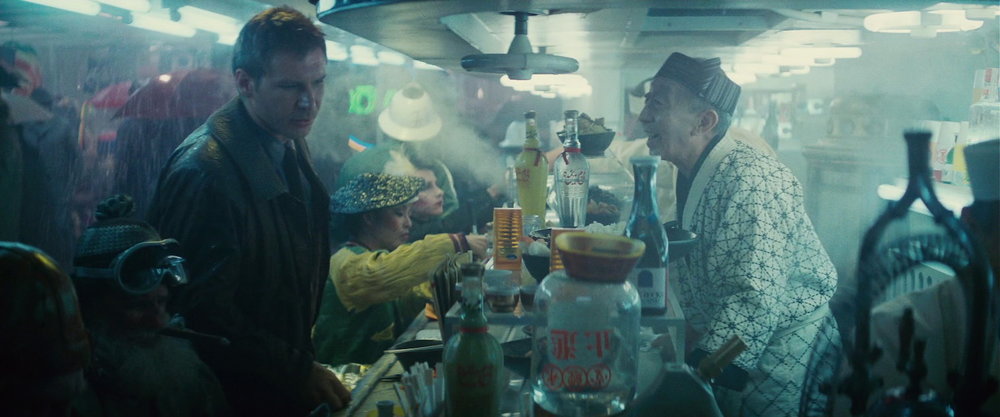
Mysteries are well suited to dungeon crawling RPGs in the classic midwestern folk tradition. Someone has set out bits of useful information for you to explore and find and put to use, with possible rewards at the end. It’s the same premise. Mothership specifically lends itself to mystery, with Solving being one of its core tenets and Blade Runner being among its big inspirations.

There are mystery adventures for MoSh already - my own Piece By Piece is an X-Files style one-shot murder case, and there’s the tense social investigation of Picket Line Tango. Every module has some element of investigation, really. But what does it mean to expand from an adventure to a setting?

Long-running mystery series, from classic detective fiction to TV, run on their investigators. What energy does the lead sleuth bring to each case? And so for a Mothership setting we look to our PCs. Fragile but skilled, outgunned but clever, crucially working class.

The default for mystery fiction is cop, but thankfully there are plenty of alternatives. Private eyes, writers in over their heads, precocious teens and their dogs. What we’re asking here is the key question for most ttrpg settings - who are these people and what are they doing? This gives us the basis of our setting but also sets up the players, informs their characters’ actions and invites them in.

This but Agatha Christie

In Odai 57, my mystery-driven phonebook setting for the Mothership RPG, players are maintenance workers. They get called in to fix things on the titular space station, a stopping point in the Qilin Gate Company’s astral gate network.

Each job is its own case, an investigative adventure in which getting to the root of a technical issue on Odai 57 (the Solve) leads the players and the residents of the station’s Commercial district into danger (the Survive and the Save). While each job works as a disconnected one-shot, stringing them all together reveals a complete setting, and possibly a larger conspiracy…

It’s Twin Peaks in an airport mall.

(Also - I know MoSh is a horror game and this doesn’t sound like the scariest place to be. But neither did Elm Street until there was a Nightmare on it. This is a different flavour of horror than typical for Mothership, not the uncaring void of space but the insidious darkness in the shadows of suburbia.)

I’ve been at work on this project for a while already, and honestly I feel like I’m just getting started. This thing is going to be enormous. Like I’ve said before, this is all deliberately crafted adventure content, little to no random generation or work for the Warden.

Each case is a complete standalone pamphlet adventure, though every one impacts the wider setting in some way, from introducing a killer who may strike again to offering player upgrades. And while some span multiple phone numbers, some are at the end of just one call. At the rate I’m going I’m looking at upwards of 30 interlinked adventures before I’m done.

But! I don’t have the time or frankly the funds to work away at a project this big. I’d turn to Kickstarter but… ugh. So here’s what I’m thinking.
This but he’s the guy who’s come to do your wifi

Right now, three of the adventures are closest to completion, with a couple of them 100% written. These are:

Odd Jobs. An introductory adventure that gets players set up on Odai 57, eases them into the setting’s quirks and sets them on a few errands around town, with clues to a potentially deadly secret linking them all together. Vibe: small town sheriff’s department by way of The Wrong Trousers

All The Fun of the Fair. An investigation into old tech going haywire in Odai 57’s derelict amusement park quickly turns into a destructive chase with a despicable villain. Vibe: Scooby-Doo gone very, very wrong

Murder On Line One. An android shows up dead next to a public phone. Your job is to clean up the mess, not investigate a murder. But it looks like this case is going to keep causing problems… Vibe: Classic hardboiled noir with a Mothership twist

I’m putting up an ashcan version of All The Fun of the Fair, by far the easiest of the three to run standalone, for download. This ain’t going to be pretty, I’m doing the layout and scribbling some art myself, but it’s a complete adventure, as good as the best stuff I’ve done, finished and playable.

In lieu of a crowdfunding campaign, I’m selling this for £10. I get that that’s a lot for one pamphlet, but think of this like a donation to the overall project. I’m going to work on getting ashcan versions of the other two done as well, so bare minimum you’ll end up with for your tenner is a three-pamphlet miniseries, which seems like a better deal to me.

Realistically, any money I make off these is going to rent and bills first, but if I get enough support I’m going to fold it back into making these adventures better. I’ve got great plans and some amazing potential collaborators lined up, and I’d love to turn this into like a digital starter pack for the setting, maybe with some cool extra add-on materials too.

So, the plan:

- Ashcan versions of three cases.

- Any profit from those gets put into making the final files.

- If there’s enough support and interest I can continue adding cases, until the whole setting is done!

- Maybe, eventually, collect it all in one big physical phonebook?

If the final thing ends up being worth more than £10 I’ll up the price accordingly, but obviously anyone who’s already bought it will continue to get new files and updates for free. So what you get for your contribution is up to you.

Honestly I have no idea if this will work out. I’m basically just gauging interest. I’d love it if this were a project I was able to focus on, but what I want to make and what people want to play don’t always align. So if this is something you want to see more of, please support in whatever way you can - you can buy the ashcan and get in on the ground floor, or post about it and share it with your group.

If anyone buys it I’ll know I’m onto something! And if I can sell like 50 of these in the next month or so I’ll be off to the races. If not, no harm done. I’ll do the three ashcan pamphlets at the very least, and then move on to the next thing probably.

Anyway, that’s all that. You can buy the ashcan version of All The Fun of the Fair here, and doing so will get you any and all upcoming updates for free. Thank you!

*

General maintenance crew wanted for immediate start. Unskilled labour, minimum wage. For further enquiries call 00-57-01 or report to:
Maintenance Office
QGC Utilities Building
01 Commercial District
Odai 57
Odai System
GC101.108.977

Tuesday, 22 August 2023

Cities of Phones

 So in a recent post I had some vague thoughts about laying a city out like a dungeon. This makes the city feel a certain way: lets you spotlight traversal, define areas and position them in relation to one another, use encounter systems to emulate a vibe. This city will probably feel busy, maze-like, claustrophobic and sprawling, with a stable concrete layout made ever-changing by its inhabitants and happenings.

But that’s not all a city can be. I don’t feel like I’m traversing a dungeon when I head out into my city. I’m not delving or dealing with encounters, I’m moving freely and easily. I don’t have to learn complex systems, I have them internalised or handled for me - I can roll onto a bus or train or DLR, zone out and my destination comes up to meet me. I barely think about where places are in relation to one another, except to decide if I should just walk or not. I don’t drive, so I don’t have personal dungeoneering costs or equipment to maintain. Apps and contactless payments handle my journey. It’s not a quest… it’s not a dungeon.

So if we don’t want to focus on traversal, or encounters, or even where locations are in relation to one another, how else can we define a space? And why might we want to, what new game modes or vibes could open up to us?

In that post I briefly mentioned a Big Thing I’ve been working on, so I figured I might as well share!

Short answer, it’s a phone book. d100 phone numbers, each with a location on the other end. (Yes these are landline phones, this is Mothership.) Players can use the phone network in-game, but also travelling around between these placers is just as easy as calling. It’s a table of contents, a list of locations they can pick from as and when they want. In the same way that I can just decide to stroll up the high street and walk into any of the shops in any order or combination, the focus here isn’t on movement and space but on an open and accessible list, the points without the crawl.

So here’s what I’ve been working on and a few things I’ve found out so far. Hopefully this is useful to anyone who might want to do something similar!

The biggest drawback as I’ve seen it is that you need all your bits written up front. In a big dungeon-city I can make one “floor” or less at a time, and expand as and when the players get to the edge of my map. Here, every phone number needs to work straight away or it all falls apart. I can mitigate this with generators somewhat - different reasons a number might be disconnected, “filler” entry tables. But it works best with a whole lot of bespoke, specific gameable bits, so that’s what I’ve been doing.

I’ve found it easiest to do what I normally do, small individual adventures, and mosaic those into a complete whole. So one phone number might have its own complete mini-adventure at the end of it, or one adventure could be spaced across a few locations that lead to one another. Each adds a little bit to the city overall, and while I prefer to keep things modular I can sprinkle in some interconnected-ness to keep the space feeling cohesive. And numbers can be reused ofc. I can also fill out more numbers with non-adventure-specific game bits, like some of the item-list vendors I’ve posted here already.

The space, btw, is not a whole city. d100 carefully planned locations is a whole lot of game for me to write but is maybe one road’s worth of landlines in the real world. So this is a high street, a typical commercial/residential space, on a space station to give the space clear edges. I’m folding in some of the “at the gates of dawn” setting stuff I’ve posted here too, but the overall size and shape is something like an airport mall in a Stanford torus.

That means I’ve got more than enough distinct locations to be getting on with, without overwhelming the Warden with millions of phone numbers and characters to keep track of. Keeping things modular in individual adventures with their own relevant subset of numbers helps here too. Also means I don’t have to write as much, so I can focus on those deliberately constructed details over generators to fill things out. Detail makes space in ttrpgs anyway. I don’t even have close to d100 yet and this place already feels huge.

So what kind of a city does all this give us, and what kind of a game? I’ll go into that next time!

Friday, 18 August 2023

WEAPONS TEST 023 is out now!

Travel through a war-torn wasteland in this sportswear-sponsored suicide mission for the Mothership Sci-Fi Horror RPG.

Art by Zach Hazard Vaupen

Tuesday, 1 August 2023

Cities of Rooms

Whew, things got shaky for a minute there. Just about levelling out, thanks in no small part to some fine folks offering work, so you’ll be seeing some cool new projects before too long. Thanks all.


Not much chance to go out and do fun stuff in July but I did catch a showing of the Cowboy Bebop movie Knockin’ On Heaven’s Door. I hadn’t seen it not-dubbed before which was interesting, lovely old 35mm print too... you’re lucky this isn’t a film blog. Suffice it to say it’s a worthy accompaniment to the classic series, recommended. (Cowboy Bebop is my touchstone for Mothership. I don’t recall the exact timeline because I definitely saw Alien for the first time that year, but I don’t think I’d seen it when I did The Haunting of Ypsilon 14 - I had seen the homage episode from Bebop though. Anyway.)

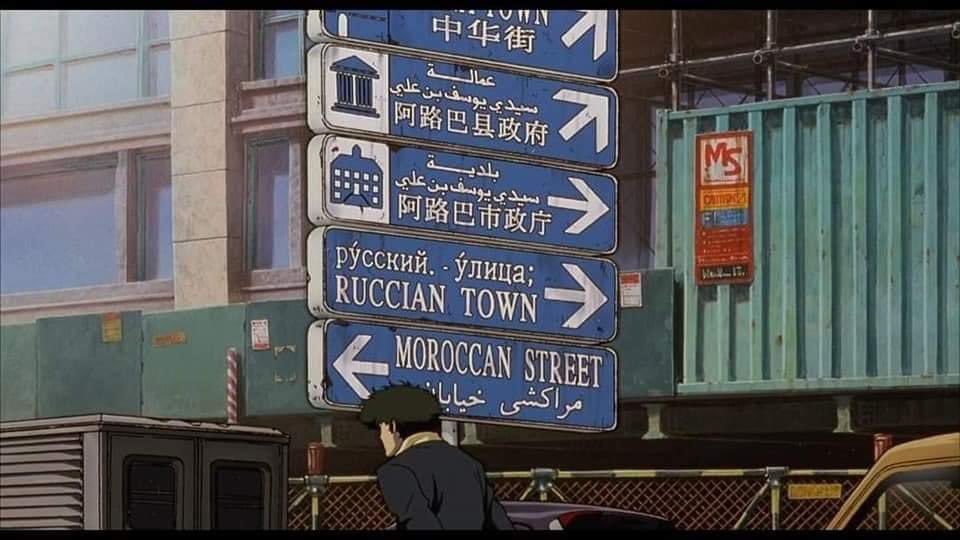
In one of my favourite sequences in the movie, we see a montage of Spike doing some on-the-ground detective work around Mars’ Alba City’s Moroccan district. (Ok a little film nerd time - the production team wanted a vibe that set this place apart from their mostly Pan-Asian/European settings in the series, so they visited Morocco and it really shows. Some of the best painted backgrounds in the film here, and that lovely “real”, lived-in vibe that permeates so much of the show. And it’s all set to this, a great 00s-gone-old-school working class country love song, but in-universe! So good.)

Anyway, the next day or whenever I was watching North American urbanism videos on YouTube, which I do sometimes to feel better about my own life, and this popped up. Take what you will from the overall message but the bit about parts of cities being like outdoor rooms with buildings and other features as walls stood out to me. In gaming, granular city maps are often designed this way, but the real world context and application just connected some more dots for me I guess.

So what’s my point? Well like I said I’m hard at work atm, so I don’t have the headspace to come up with new examples for this post, but it got me thinking about laying out a city more like a dungeon. This is nothing new, but I specifically mean a MoSh city as a MoSh style flowchart map. Transit maps like the good old Tube are essentially circuit diagrams after all, and maps as a series of connections rather than a representation of physical space makes sense in a setting where you can just walk anywhere anyway (I have more thoughts on different ways to represent city space but you’ll have to wait for a particular Big Thing).

And if our districts and streets are rooms, and our flowchart lines are transit connections, then we get interesting choices coming up around traversal. Do the players take the subway to the other side of town or walk the whole way, triggering encounters? Does the subway cost money or have its own encounters, and how does that factor into decision-making? Are there places they’ve been told to avoid, and what will they see as they loop around them? If a place they need to get to is only two stops away, why not save on travel and walk, thereby triggering a whole other event in the spaces between? If they can find a way through the front of a building in one area and out the back into another, can they establish new shortcuts and routes themselves? What about transit strikes? (Great transit scene in the movie too btw, more inspiration.)

And that’s as much as I’ve got today. Electric Bastionland encourages you to lay out a Tube-style map, which is worth a look. And I will, as always, recommend Cowboy Bebop. tschuss x

Are you living in the real world?

Tuesday, 4 July 2023

It Came From The Blogosphere… Again!

 Ok don’t get too used to these. But since the second I posted my last roundup of fun blog stuff I’d been reading, I’ve been finding more and more.

Rey and Grey are in the process of getting BREAK!! made, and Rey did a kind of retrospective video on the game’s long development process here. (Speaking of YouTube, I mentioned the Bastionland broadcast in the last blogosphere post, and then in Chris’s very next video he gave the Graverobber’s Guide a shoutout! Which was nice. So if you’re here from there, hi.)

Here’s To Distant Lands talking about Zelda-style NPCs. TOTK has some really top notch NPC writing, and this post seems like a great way to capture some of that energy - with actual, practical tables and stuff.

Bait’s Terrifying Cuisine is getting a fancy new reprint! Here’s creator Giuliano Roverato talking about how it was made. One of the great adventures, imo.

You know I like words, right? Here’s 100 good words from Throne of Salt.

The Alexandrian categorises dungeons by size. What I really like here is the bit about expedition-style play.

Benign Brown Beast has a system for tracking movement through space, and the example catacomb dungeon makes it even more my jam tbh

The Dododecahedron talks about toolbox design. A nice summary of the kind of gameplay I enjoy too!

Someone on Reddit of all places made an rpg using only 3 (or fewer) letter words. May be fun, can you try it?

Skerples works on their new setting by going over some original, obscure Arthurian texts. Very cool

Nate Treme’s budget banh mi recipe 


And that’s it for this time around!

I may be posting a bit less frequently - WEAPONS TEST 023 is due to come out this month, and Twitter dying slowly means that I’m seeing less cool stuff (also less of all the other stuff, which is a plus).

I also got some pretty dire financial news unfortunately, as my income for this month has disappeared overnight. So we’ll have to see how sustainable blogging and game stuff is going forward.

If anyone is in need of any system/adventure writing, or editing/proofreading services, I’d appreciate the work - email me at graverobbersguide(at)gmail(dot)com. You can also buy my stuff here.

Hopefully I’ll be back on my feet and posting here again soon :)

Tuesday, 27 June 2023

Combo Encounters


I’m a big proponent of rolling twice on an encounter table and combining the results. 1d6 goblins plus a wandering knight becomes stumbling across a knight fending off goblins mid-battle, or a lost knight who has convinced the gobbos she is their god and keeps giving you “play along” looks, or whatever.

However! I’m also a big proponent of not making extra work at the table. Work isn’t bad, and games probably aren’t games if there isn’t at least a *little* work somewhere, but at the end of the day we’re here to play. And making stuff up on the spot is work, even if it can be fun, and gets in the way of play.

So instead of getting the GM to come up with what these combos mean at the table, how about writing your encounter tables as a list of combos in the first place? This has the added benefit of starting a lot of your writing for you - coming up with 3 encounters, then combining them in every possible way (1+1, 1+2, 1+3, 2+2, 2+3 and 3+3) basically doubles your initial ideas. You can also show some of the location’s faction interactions of ecology in a more direct and useful way.

This example table is loosely based on the first “stratum” of the megadungeon in Etrian Odyssey V (which I recently dredged up my old 3DS to play again once I saw how much they’re charging for the new Switch remasters). That game has some fun inter-monster interactions in encounters, but with our medium we can of course go further!

1. Acorn-men + Acorn-men. These cheeky little bastards are born when wildfire spirits settle in hollow nuts and fruit pits. Love making noise and mischief. Water douses their spark. When multiple groups gather, they have loud and raucous parties that can start forest fires if left unchecked.

2. Acorn-men + Wild hog. Hogs love eating fallen nuts from the forest floor, and do not seem to care if the nuts come alive and protest. Consuming the wildfire spirits within gives them temporary flame breath.

3. Acorn-men + Flinging vine. The long, green tendrils that hang from boughs here are in fact not vines but a type of parasite. They are blind but react to touch, coiling their sticky bodies around their victims and bashing them against tree trunks or throwing them as far as they can. This causes the acorn-men to explode.

4. Wild hog + Wild hog. A breeding pair, the larger stronger female holding back unless threatened, the smaller, aggressive male picking fights with anything that enters their territory. As they need to bulk up to feed and defend the coming offspring, they are easily distracted by food and will go for the simplest target.

5. Wild hog + flinging vine. Smaller hogs are easily flung aside and know to stay away. The largest seem to enjoy the tug of war and sometimes even pull the parasites down from their perches. The disconnected vine then flails wildly like a whip, sticking fast to the hog until it dies.

6. Flinging vine + Flinging vine. When two or more vines get tangled, they unintentionally create a deadly trap. Touching the knotted vines causes them all to pull and attempt flinging at once, which can bring down the trees they are attached to and crush their would-be prey.

Friday, 16 June 2023

1d6 Fun Crimes

 I love character creation in Graverobbers. It can take less than a minute, it’s thematically relevant and you can die. That being said what’s out right now is still the Bare Bones, and I’ve had all sorts of ideas rattling around for how to flesh them out, add more (optional) steps to chargen.

The issue is the same one that always occurs when adding rules, especially to minimalist stuff, which is whether the added steps of mechanical complexity justify their effects. I’m a harsh judge of this stuff, and none of my previous concepts panned out. I wanted something like MoSh’s d100 patches or trinkets, elegant and dense with flavour, but more specific. Also something tuned as much towards straight up gameability as character - like Bastionland’s failed careers (check last post for a great video on these)

Anyway, long story long, this week I cracked it. The way the Pocket Guide is shaping up so far there’ll be a little space, so right now the plan is to fill it with d66 Minor Offences. These are extra crimes to accuse your characters of during creation. Nothing as involved or career-criminal as the main Crimes, but still actual things from London’s irl history.

They’re mainly about selling, stealing, swindling or causing some kind of public nuisance. Each comes with one item, and I’m already having way too much fun rolling up little weirdos and seeing how these juxtapose with the other facets on the sheet. And just seeing them all in a list gives me the clearest image I’ve had of this city of criminals. Can’t wait to share.

While I tinker with these and get them to play testing, there are exactly 6 in the list that my word processor is putting that squiggly red line underneath that says they’re not real words. They are, just obsolete - so I thought I’d do a little dive on each one and its real history!


Cogger. Just an old word for a dice cheat, cog meaning “trick” but generally around games of dice. Nothing that fun around this one but it’s a nice word, and the item you get with it (pair of dice, 4d) makes it self-explanatory. As I’ve said before, any time i use a weird old word or esoteric reference it should be clear from context or eminently googleable

Maltooler. So as it turns out Victorian London had a lot of specific words for pickpockets and petty thieves, dependent on what one was stealing and how. An old version of this list had more of them but I whittled it down to the best ones. A Maltooler used specialist tools to pickpocket as opposed to doing it by hand, things like little knives to cut purses or even tiny mechanical grabber claws. my version starts with a magnet which is fun

Overmourner. The only one that’s not a word - overmourn is, and means what you think. But did you know it’s illegal in England to linger at a grave after a funeral? I could find records from as recently as 2015 of someone getting the rozzers called on them and incurring a fine for lingering too long at a loved one’s graveside. This fucking country man

Pudding-snammer. One of the highly specific thief terms. These were people who grabbed stuff off you as you were exiting, say, a bakery. I enjoy that these say as much or as little as you want about a character - remembering that these are alleged crimes. Maybe you bought that apple turnover fair and square, who’s to say.

Tregetour. Someone who does tricks and magic, often a juggler which is the usage I’m going for here. A lot of these petty crimes are victimless, just people going about their day or trying to earn a living, but the idea is that players get more of an insight into the anti-canon and what exactly the House considers worthy of legal retribution.

Whipjack. And finally… a couple on the list are terms for specific varieties of scam artist. A whipjack is someone who pretended to be a sailor, out of luck and stranded due to a shipwreck or some such. Like this one guy who for years used to push his motorbike up and down a street near me, stop cars and ask for petrol money. Wonder where he is now. Probably not far, he’s got no petrol.


The final list will have 30 more of these, and you’ll find it in the Pocket Guide to Smocklehythe or some supplementary material thereof. Get it now while it’s cheap!