The one problem with being super productive and working on a lot of cool RPG shit is that I don't have any time to post stuff here 🙃
So, this week, I'm pointing you in the direction of a bundle of RPG goodness.
I'm talking Hot Springs Island, I'm talking Slumbering Ursine Dunes... Veins of the Earth even! Plus w hole bunch of other stuff (like, the entire Doctor Who RPG core book, I think??).
It's only $25 USD for nearly $500 worth of content, and the money goes to support ConTessa, who work at creating spaces for women and marginalised folks at gaming conventions.
Some of the best RPG modules of the century are in there! Get on it! I don't know how long it's online for so be quick!
***
We'll be back to posting next month! I have some fun OSR/system neutral content lined up (random tables boiiii), and I might talk more about that game I'm working on... also a whole other project I'm working on that's not strictly OSR but is really fuckin cool?!
Be excellent to each other ✌️
Thursday, 26 April 2018

Sunday, 15 April 2018
Design Document: Three Basic Classes
Here's a little something about the game I'm working on. Specifically, how I approached class design, looking at the three "standard" classes: Warrior, Thief and Mage.
(I think there'll be one or two more posts in this vein for now, then we'll return to Your Regularly Scheduled Programming. Or maybe I'll start talking about another game! Who knows.)
***
Classes in this game are simple. At first, a class was just a single ability you got - like in Maze Rats or Songbirds. I expanded a bit on this concept, but didn't go far.
The basics of a class in this system are:
- a Stat requirement. You need a certain stat to have at least a positive modifier to take a class.
- Abilities. You get 3 - 2 passive and 1 active, that you activate by spending 1 HP. I talked a bit last post about how scarce and valuable HP is as a resource in this system; 1 HP is pretty significant.
- Starting items.
And that's it. The Stat requirement isn't a favourite feature of mine from other games or anything, but it makes sense in this system - you don't get new features or abilities as you level up. But your abilities are tied to your Stats, and so as they increase (every other level gets you a +1), your abilities become more potent by default.
The idea, as with much of this game, was keeping things minimal. Instead of introducing a new mechanic, have a mechanic that already exists power something else in the system.
(I try and do this as much as I can in games - it's just good design. Mario can run and jump, and that's it, but you're never bored or stuck for things to do in a Mario game. Jumping could mean over a pit, onto an enemy's head, to reach a platform or hit a box... permutations of a central mechanic, rather than new mechanics for no reason.)
Knight
The "fighter" class in this game is called the Knight. I could have just called it the Fighter, or the Warrior, but Knight invokes a particular image - that of a noble protector.
No class ability in this game is combat-specific. There are a few that are inherently useful in combat situations, but nothing powers up your attacks in that sense.
So, the Knight gets powers based on protection. Their AC can effectively go 1 higher than any other class - and in a game where the numbers are as tight as this one, +1 AC is massive. Their other passive is Expertise with several different weapons (Expertise gives advantage on rolls). It's pretty much an attack bonus, I suppose, but it also covers knowledge of weaponry and warfare, so it's not combat-specific. Again - nothing in the game is.
The Knight's active skill, the one that costs them 1 HP to use, negates all damage done to an ally from a single action. Falling into a spike trap? The Knight caught the scruff of your jacket and pulled you to safety, you take no damage. Dragon's breath? As you flinch and prepare to be burnt to charcoal, you feel a wave of heat but nothing more - you open your yes to see the Knight standing before you, shield raised, the flames streaming all around you but not touching you.
So, we have a character recognisable as an archetypal Knight. Trained with various weapons, well armoured and protective of both themselves and their friends. And we did it all without any abilities that only work in combat.
Shadow
The rogue in D&D is second to only the Ranger in the way it has been forced and stuck into several different design corners by the game's long legacy. It's the dungeoneering class, a product of the game's own idiosyncracies. A rogue should be able to sneak around, to check for and disable traps, pick locks and climb walls, but also fight well and in a very particular way, and maybe assassinate people, oh, and be very charming and deceptive...
It's a lot more specific than the warrior archetype, that's for sure. For this game, I distilled the Shadow into one facet, one of the earliest aspects of its design - the sneaking.
A Shadow can roll any roll to hide or move unseen with advantage. That's huge. It's maybe the single most powerful passive ability in the game. Rolls in this game are like saving throws, not skill checks - you'd really rather not be making them at all. Flat advantage cements the Shadow as the party's master of stealth, in a game where character skill levels generally start out from average to appalling.
The other passive is Expertise with a light weapon - they need something to do other than hide. Their active ability is to double the bonus they get from their Stat when making the game's equivalent of DEX saves. If a +1 is huge, doubling a Stat is insane. At high levels, the Shadow can spend 1 HP to just straight up Not Fail - the bonus alone would go above the threshold for instant success without a die being rolled at all. Plus, this doubling can be done retroactively, so the player has the option to "fix" an unlucky roll.
Sneaky, backstabby. Done. All the other stuff is up to the player.
Witch
I don't like spell slots, or the way magic works in old-school games in general. I didn't grow up reading Vance, I didn't grow up playing D&D, so I have no nostalgia or love for the concept. The magic systems I'm familiar with involve something simple like Mana Points or just Doing The Magic, not waking up and preparing spells from spells you know but forgot but now you know them again except not really and you can't use this spell but you can use that one but it would mean you can't do any more of the other one until... the next day? What?
I get that it works, kind of, in a game mechanic way. It's just far too long a walk for what should be a short drink of water.
The Witch class is a gardener - their passives are knowledge of plants and fungi, and general plant-y abilities, including meditating to find food, light and/or water. Their active is their "proper" spellcasting, which instantly summons a full-grown plant.
D&D spells are great. Grease, Rope Trick, Speak with Dead... their inherent use is obvious, and their potential use so varied that a creative magic user always has some bonkers but surprisingly relevant trick up their sleeve. They're one of the best things about OSR gaming.
They can also all easily be plants. The Witch starts out able to grow trees and vines (ropes! cages! bridges! shields! growing a tree straight up into a guy and killing him outright!), and they can also study a plant for an hour to learn how to grow that one too. This allows for one concept of D&D spellcasting that I like quite a bit - copying things into your spellbook - but also lets the player take matters into their own hands a bit more, rather than waiting for the GM to throw them a bone with a scroll in a treasure chest or That One Book in a whole library.
And if the GM does want to throw them a bone: carnivorous plants, ones that put you to sleep if you smell them, ones with leaves big and buoyant enough to be rafts, ones that let you speak to ghosts if you shave the root and chew it betwixt your back teeth while standing in moonlight...
And so, we have a caster as versatile as a wizard, with a spellcasting system that can be explained in a sentence rather than half a core rulebook.
***
Job done.
There are other classes in the game - 9 total so far - and the others get weirder. I just thought that covering the bases people expect of a fantasy adventure game would be wise, and I want those bases covered as much as the next guy too.
Next week... I dunno. Something.
(I think there'll be one or two more posts in this vein for now, then we'll return to Your Regularly Scheduled Programming. Or maybe I'll start talking about another game! Who knows.)
***
Classes in this game are simple. At first, a class was just a single ability you got - like in Maze Rats or Songbirds. I expanded a bit on this concept, but didn't go far.
The basics of a class in this system are:
- a Stat requirement. You need a certain stat to have at least a positive modifier to take a class.
- Abilities. You get 3 - 2 passive and 1 active, that you activate by spending 1 HP. I talked a bit last post about how scarce and valuable HP is as a resource in this system; 1 HP is pretty significant.
- Starting items.
And that's it. The Stat requirement isn't a favourite feature of mine from other games or anything, but it makes sense in this system - you don't get new features or abilities as you level up. But your abilities are tied to your Stats, and so as they increase (every other level gets you a +1), your abilities become more potent by default.
The idea, as with much of this game, was keeping things minimal. Instead of introducing a new mechanic, have a mechanic that already exists power something else in the system.
(I try and do this as much as I can in games - it's just good design. Mario can run and jump, and that's it, but you're never bored or stuck for things to do in a Mario game. Jumping could mean over a pit, onto an enemy's head, to reach a platform or hit a box... permutations of a central mechanic, rather than new mechanics for no reason.)
Knight
The "fighter" class in this game is called the Knight. I could have just called it the Fighter, or the Warrior, but Knight invokes a particular image - that of a noble protector.
No class ability in this game is combat-specific. There are a few that are inherently useful in combat situations, but nothing powers up your attacks in that sense.
So, the Knight gets powers based on protection. Their AC can effectively go 1 higher than any other class - and in a game where the numbers are as tight as this one, +1 AC is massive. Their other passive is Expertise with several different weapons (Expertise gives advantage on rolls). It's pretty much an attack bonus, I suppose, but it also covers knowledge of weaponry and warfare, so it's not combat-specific. Again - nothing in the game is.
The Knight's active skill, the one that costs them 1 HP to use, negates all damage done to an ally from a single action. Falling into a spike trap? The Knight caught the scruff of your jacket and pulled you to safety, you take no damage. Dragon's breath? As you flinch and prepare to be burnt to charcoal, you feel a wave of heat but nothing more - you open your yes to see the Knight standing before you, shield raised, the flames streaming all around you but not touching you.
So, we have a character recognisable as an archetypal Knight. Trained with various weapons, well armoured and protective of both themselves and their friends. And we did it all without any abilities that only work in combat.
Shadow
The rogue in D&D is second to only the Ranger in the way it has been forced and stuck into several different design corners by the game's long legacy. It's the dungeoneering class, a product of the game's own idiosyncracies. A rogue should be able to sneak around, to check for and disable traps, pick locks and climb walls, but also fight well and in a very particular way, and maybe assassinate people, oh, and be very charming and deceptive...
It's a lot more specific than the warrior archetype, that's for sure. For this game, I distilled the Shadow into one facet, one of the earliest aspects of its design - the sneaking.
A Shadow can roll any roll to hide or move unseen with advantage. That's huge. It's maybe the single most powerful passive ability in the game. Rolls in this game are like saving throws, not skill checks - you'd really rather not be making them at all. Flat advantage cements the Shadow as the party's master of stealth, in a game where character skill levels generally start out from average to appalling.
The other passive is Expertise with a light weapon - they need something to do other than hide. Their active ability is to double the bonus they get from their Stat when making the game's equivalent of DEX saves. If a +1 is huge, doubling a Stat is insane. At high levels, the Shadow can spend 1 HP to just straight up Not Fail - the bonus alone would go above the threshold for instant success without a die being rolled at all. Plus, this doubling can be done retroactively, so the player has the option to "fix" an unlucky roll.
Sneaky, backstabby. Done. All the other stuff is up to the player.
Witch
I don't like spell slots, or the way magic works in old-school games in general. I didn't grow up reading Vance, I didn't grow up playing D&D, so I have no nostalgia or love for the concept. The magic systems I'm familiar with involve something simple like Mana Points or just Doing The Magic, not waking up and preparing spells from spells you know but forgot but now you know them again except not really and you can't use this spell but you can use that one but it would mean you can't do any more of the other one until... the next day? What?
I get that it works, kind of, in a game mechanic way. It's just far too long a walk for what should be a short drink of water.
The Witch class is a gardener - their passives are knowledge of plants and fungi, and general plant-y abilities, including meditating to find food, light and/or water. Their active is their "proper" spellcasting, which instantly summons a full-grown plant.
D&D spells are great. Grease, Rope Trick, Speak with Dead... their inherent use is obvious, and their potential use so varied that a creative magic user always has some bonkers but surprisingly relevant trick up their sleeve. They're one of the best things about OSR gaming.
They can also all easily be plants. The Witch starts out able to grow trees and vines (ropes! cages! bridges! shields! growing a tree straight up into a guy and killing him outright!), and they can also study a plant for an hour to learn how to grow that one too. This allows for one concept of D&D spellcasting that I like quite a bit - copying things into your spellbook - but also lets the player take matters into their own hands a bit more, rather than waiting for the GM to throw them a bone with a scroll in a treasure chest or That One Book in a whole library.
And if the GM does want to throw them a bone: carnivorous plants, ones that put you to sleep if you smell them, ones with leaves big and buoyant enough to be rafts, ones that let you speak to ghosts if you shave the root and chew it betwixt your back teeth while standing in moonlight...
And so, we have a caster as versatile as a wizard, with a spellcasting system that can be explained in a sentence rather than half a core rulebook.
***
Job done.
There are other classes in the game - 9 total so far - and the others get weirder. I just thought that covering the bases people expect of a fantasy adventure game would be wise, and I want those bases covered as much as the next guy too.
Next week... I dunno. Something.
Wednesday, 4 April 2018
Steven Universe: OSR Hero
With the vast majority of DIY RPG content fitting into traditional dungeon fantasy and/or gothic horror and/or the New Weird, a lot of assumptions get made about the style of play in OSR being inherently grim and/or dark and/or grimdark.
There's been a fair amount written already, however, about how Romantic Fantasy fits into OSR play almost surprisingly well. Characters tend to avoid combat and seek other solutions? Check. Characters have picaresque adventures, collecting allies and influencing the world with their decisions? Check. The impetus for traditional modes of play may be a little different in a Romantic setting, but those same mechanical structures support this genre just as well as the standard OSR fare.

When making a game, I tend to think of a story that captures the intended genre well, and think through whether that story could emerge from a session of the game. Obviously this works better with narrative rulesets than trad games, but it's a decent benchmark. If the rules don't even slightly allow for the kind of story I expect the game to result in, I know I'm way off.
So, to run this little test with the game I'm working on now, let's take one of the best examples of current Romantic fantasy: the kids' cartoon Steven Universe. The show is about a kid who fights alongside a superhero team from outer space, using empathy as well as magic powers to protect Earth from monsters and aliens.
Its modern-fantasy setting has a few similarities to my system, so it seems like a decent fit. The aesthetic and music and everything are pretty much a kid-friendly version of how the game is looking so far, even.
We'll be using Episode 1, so everything should be simple enough to pick up if you don't know the show already.
(Aside: if you decide to watch the show, bear in mind that, well, it's for kids. I personally bounced right off it the first time. There's a turning point partway through the first season, though, and a tonal shift at the end, so start there if you'd prefer.)
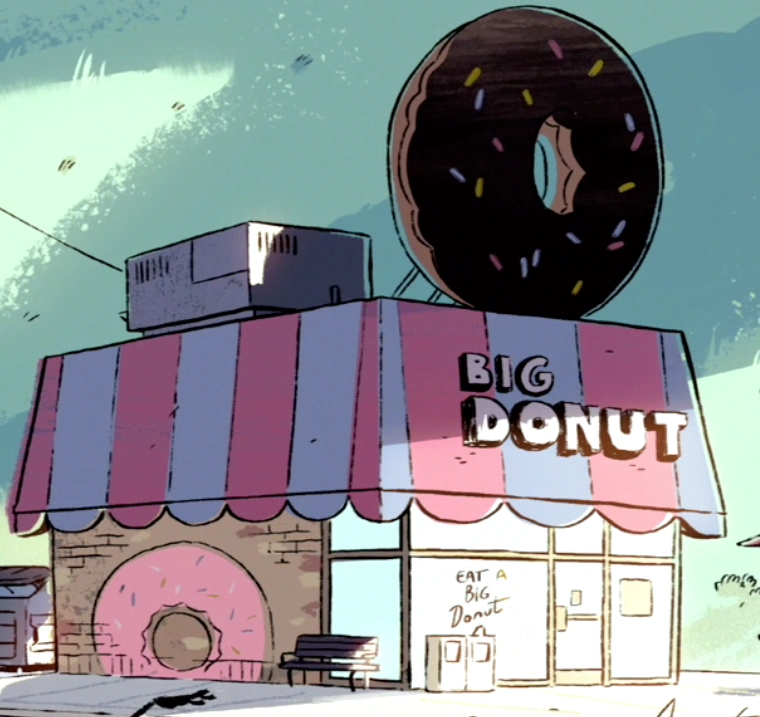
We open on Steven in the donut shop, finding out his favourite ice cream sandwich, Cookie Cat, has sold out and is no longer in production. The store owners let him take the branded freezer home.
So far, this is surprisingly well supported by the system. This would all be covered in Downtime, or maybe roleplayed briefly at the start of a session, but there's absolutely concrete rules and suggestions in the text to cover a) the existence of a particular brand of snack, b) that being Steven's favourite food, c) a shop existing in town that might sell them, and d) Steven knowing the people at the shop.
All of this handily sets up the scene, likely at the player's suggestion, and the group can roleplay from there. The GM then just has to let the player take home the freezer, which, I mean, why not.
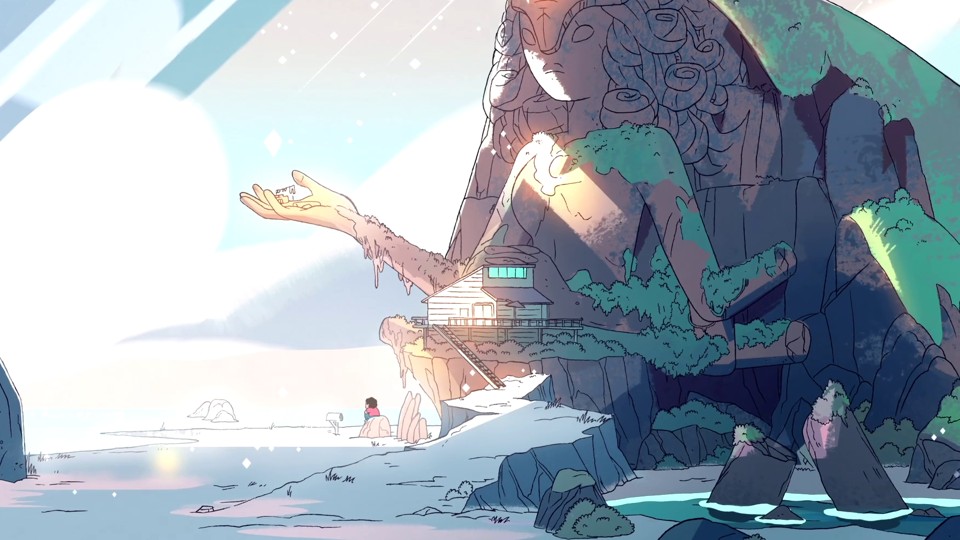
Steven goes home to his dope-ass house inside a temple inside a giant stone colossus by the beach. The other "PCs", Garnet, Amethyst and Pearl are fighting some monster insects that have overrun the place.
The Gems are probably higher level characters. I'd imagine this is Steven's player's first session, joining a group with established characters. Or, rather, it's the player's new character after their last one, Rose Quartz, died in a previous game.
So, this battle is one of three things mechanically: a few 1HP mooks being dispatched with relative ease by higher-level characters; a single monster, flavoured as a "swarm", also being fought handily; or a narrative moment the group puts in for fun. Given how little danger is presented here, I'd say one of the latter two. Full combat in this system is for moments of intense peril.
The GM uses this fight to establish that the creatures have acid spit. They also let the players know more about the bugs (there's a mother nearby), by telling Garnet's player that she knows the information already. The text supports and reinforces this kind of openness with information. Garnet might even have something on her character sheet to justify the GM's exposition.
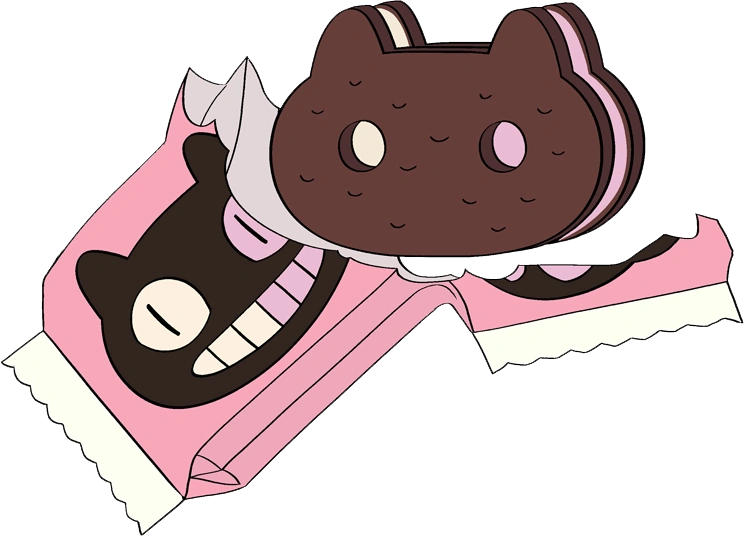
There's a cute moment where the Gems have bought Steven a freezer full of Cookie Cats, and Steven sings the theme song from the TV ad (unknowingly foreshadowing a lot of the show's lore). There's a lot of establishing of the Gems' personalities and characters as they try to teach Steven how to use his Gem powers: summoning a weapon.
This is all narrative, the group's having fun with their characters. The weapon summoning might be pure flavour from the setting, or there are specific Classes in the game with powers that could cover this. I didn't design the game to allow players to become Crystal Gems, but I'm glad it's possible!

Steven gets his weapon - a shield - just in time, as the mother bug shows up. The Gems leap into the fray, and Steven goes to grab an extension cord so he can take his new freezer outside with him, full of the treats that he's convinced give him his powers.
Almost everything has been handled through roleplay so far, but here's where the mechanics come in. Mechanics in the game only really kick in when danger is present. Rolling generally has a high chance of failure - you don't want it to happen! Pure roleplay is the standard, until the adventure hits a snag, as adventures are won to do. This is a pretty standard OSR way of thinking, the contrast is just maybe a little more stark here.
We go into Initiative order. Steven's player spends his first round or so of combat dealing with the freezer. The player knows that the character wouldn't survive a confrontation, and hopes to set up some alternative win condition for the fight. Good player instincts! That monster could probably kill him in one hit.
The Gems are all higher level, and more capable in combat, but quickly find themselves overpowered. Mehanically, the players are aware they are losing the fight, even though the monster hasn't hit them with its acid yet. It's just a fairly standard HP system, but tightening the numbers and making a few old-school assumptions more explicit in the text should reinforce the right thinking.
This is all supported in the rules. I think we're doing well so far.

Steven's freezer gets broken, and he uses it to electrocute the monster, giving the Gems an opening to attack.
Aha! There's that OSR thinking. Your character is too weak to fight - look through your inventory and think of creative solutions to an overwhelming situation. Exactly the kind of play the game encourages.
Then it's just a matter of an attack roll or two to finish off the last of the monster's HP. The GM probably rules that it loses a turn at this point due to being stunned by the electrocution. Garnet leads the charge, and the battle is won.

(Aside: Garnet in the show is voiced by the singer Estelle, and... you guys. She uses her natural speaking voice. This means a whole lot to me. I grew up in the same part of the world, in a white-minority area, around black women who spoke just like Garnet does.
That accent was my daily reality, but I never saw it represented on TV - definitely not from black women, and definitely not from a positive, strong, competent and complex character. Garnet existing makes me so happy.)
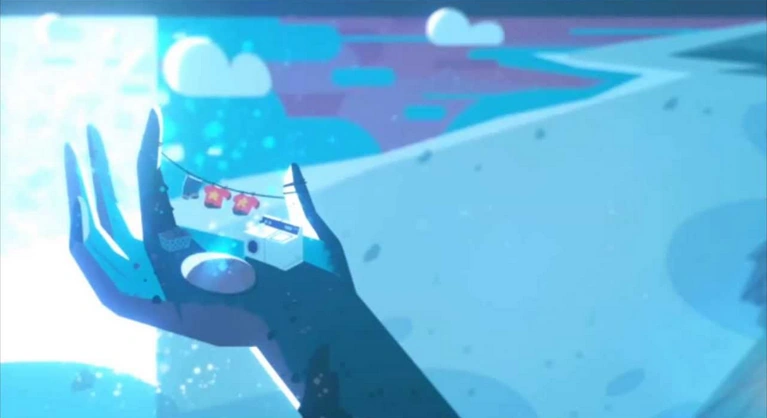
Steven has a funeral for the ice cream wrappers, everyone's happy, the fight is over, Steven throws up from eating too much ice cream.
... And the rest is all narrative. That's, what, half an hour or so of play? Not bad.
The main ways the mechanics came through were in the setup of the situation, and in the execution of the fight. I didn't go super in depth on rolls etc in combat, that wouldn't be an interesting read, but I think the fight managed to deliver. What might not have been clear is just how deadly it was - the gang barely survived. Combat in this game is rough. HP levels are closer to HD levels in other OSR systems, so every hit really fucking counts.
***
All in all, I feel like that would be a strong opener to a campaign. The mechanics held up well under examination, particularly with the two key aspects of the episode: the initial setup and the fight. The rest being largely handled just by fiction rather than mechanics is pretty ideal too. This isn't a system that puts mechanical restrictions on any of that sort of stuff, players can just roleplay without rolling for the most part. That's how I like it.
I think this was a valuable exercise, even considering that this isn't a narrative system, and doesn't have mechanics in place to produce story. The story emerged through gameplay! The knowledge that it's even slightly feasible that this kind of story could emerge naturally through play is heartening, it means I'm on the right track. Or at least the track I wanted to be on. I'm happy with the system so far!
I'll go more into the system itself next week. We'll talk about Class design, progression and balance.
There's been a fair amount written already, however, about how Romantic Fantasy fits into OSR play almost surprisingly well. Characters tend to avoid combat and seek other solutions? Check. Characters have picaresque adventures, collecting allies and influencing the world with their decisions? Check. The impetus for traditional modes of play may be a little different in a Romantic setting, but those same mechanical structures support this genre just as well as the standard OSR fare.
When making a game, I tend to think of a story that captures the intended genre well, and think through whether that story could emerge from a session of the game. Obviously this works better with narrative rulesets than trad games, but it's a decent benchmark. If the rules don't even slightly allow for the kind of story I expect the game to result in, I know I'm way off.
So, to run this little test with the game I'm working on now, let's take one of the best examples of current Romantic fantasy: the kids' cartoon Steven Universe. The show is about a kid who fights alongside a superhero team from outer space, using empathy as well as magic powers to protect Earth from monsters and aliens.
Its modern-fantasy setting has a few similarities to my system, so it seems like a decent fit. The aesthetic and music and everything are pretty much a kid-friendly version of how the game is looking so far, even.
We'll be using Episode 1, so everything should be simple enough to pick up if you don't know the show already.
(Aside: if you decide to watch the show, bear in mind that, well, it's for kids. I personally bounced right off it the first time. There's a turning point partway through the first season, though, and a tonal shift at the end, so start there if you'd prefer.)
We open on Steven in the donut shop, finding out his favourite ice cream sandwich, Cookie Cat, has sold out and is no longer in production. The store owners let him take the branded freezer home.
So far, this is surprisingly well supported by the system. This would all be covered in Downtime, or maybe roleplayed briefly at the start of a session, but there's absolutely concrete rules and suggestions in the text to cover a) the existence of a particular brand of snack, b) that being Steven's favourite food, c) a shop existing in town that might sell them, and d) Steven knowing the people at the shop.
All of this handily sets up the scene, likely at the player's suggestion, and the group can roleplay from there. The GM then just has to let the player take home the freezer, which, I mean, why not.
Steven goes home to his dope-ass house inside a temple inside a giant stone colossus by the beach. The other "PCs", Garnet, Amethyst and Pearl are fighting some monster insects that have overrun the place.
The Gems are probably higher level characters. I'd imagine this is Steven's player's first session, joining a group with established characters. Or, rather, it's the player's new character after their last one, Rose Quartz, died in a previous game.
So, this battle is one of three things mechanically: a few 1HP mooks being dispatched with relative ease by higher-level characters; a single monster, flavoured as a "swarm", also being fought handily; or a narrative moment the group puts in for fun. Given how little danger is presented here, I'd say one of the latter two. Full combat in this system is for moments of intense peril.
The GM uses this fight to establish that the creatures have acid spit. They also let the players know more about the bugs (there's a mother nearby), by telling Garnet's player that she knows the information already. The text supports and reinforces this kind of openness with information. Garnet might even have something on her character sheet to justify the GM's exposition.
There's a cute moment where the Gems have bought Steven a freezer full of Cookie Cats, and Steven sings the theme song from the TV ad (unknowingly foreshadowing a lot of the show's lore). There's a lot of establishing of the Gems' personalities and characters as they try to teach Steven how to use his Gem powers: summoning a weapon.
This is all narrative, the group's having fun with their characters. The weapon summoning might be pure flavour from the setting, or there are specific Classes in the game with powers that could cover this. I didn't design the game to allow players to become Crystal Gems, but I'm glad it's possible!
Steven gets his weapon - a shield - just in time, as the mother bug shows up. The Gems leap into the fray, and Steven goes to grab an extension cord so he can take his new freezer outside with him, full of the treats that he's convinced give him his powers.
Almost everything has been handled through roleplay so far, but here's where the mechanics come in. Mechanics in the game only really kick in when danger is present. Rolling generally has a high chance of failure - you don't want it to happen! Pure roleplay is the standard, until the adventure hits a snag, as adventures are won to do. This is a pretty standard OSR way of thinking, the contrast is just maybe a little more stark here.
We go into Initiative order. Steven's player spends his first round or so of combat dealing with the freezer. The player knows that the character wouldn't survive a confrontation, and hopes to set up some alternative win condition for the fight. Good player instincts! That monster could probably kill him in one hit.
The Gems are all higher level, and more capable in combat, but quickly find themselves overpowered. Mehanically, the players are aware they are losing the fight, even though the monster hasn't hit them with its acid yet. It's just a fairly standard HP system, but tightening the numbers and making a few old-school assumptions more explicit in the text should reinforce the right thinking.
This is all supported in the rules. I think we're doing well so far.
Steven's freezer gets broken, and he uses it to electrocute the monster, giving the Gems an opening to attack.
Aha! There's that OSR thinking. Your character is too weak to fight - look through your inventory and think of creative solutions to an overwhelming situation. Exactly the kind of play the game encourages.
Then it's just a matter of an attack roll or two to finish off the last of the monster's HP. The GM probably rules that it loses a turn at this point due to being stunned by the electrocution. Garnet leads the charge, and the battle is won.
(Aside: Garnet in the show is voiced by the singer Estelle, and... you guys. She uses her natural speaking voice. This means a whole lot to me. I grew up in the same part of the world, in a white-minority area, around black women who spoke just like Garnet does.
That accent was my daily reality, but I never saw it represented on TV - definitely not from black women, and definitely not from a positive, strong, competent and complex character. Garnet existing makes me so happy.)
Steven has a funeral for the ice cream wrappers, everyone's happy, the fight is over, Steven throws up from eating too much ice cream.
... And the rest is all narrative. That's, what, half an hour or so of play? Not bad.
The main ways the mechanics came through were in the setup of the situation, and in the execution of the fight. I didn't go super in depth on rolls etc in combat, that wouldn't be an interesting read, but I think the fight managed to deliver. What might not have been clear is just how deadly it was - the gang barely survived. Combat in this game is rough. HP levels are closer to HD levels in other OSR systems, so every hit really fucking counts.
***
All in all, I feel like that would be a strong opener to a campaign. The mechanics held up well under examination, particularly with the two key aspects of the episode: the initial setup and the fight. The rest being largely handled just by fiction rather than mechanics is pretty ideal too. This isn't a system that puts mechanical restrictions on any of that sort of stuff, players can just roleplay without rolling for the most part. That's how I like it.
I think this was a valuable exercise, even considering that this isn't a narrative system, and doesn't have mechanics in place to produce story. The story emerged through gameplay! The knowledge that it's even slightly feasible that this kind of story could emerge naturally through play is heartening, it means I'm on the right track. Or at least the track I wanted to be on. I'm happy with the system so far!
I'll go more into the system itself next week. We'll talk about Class design, progression and balance.
Wednesday, 28 March 2018
One More Fantasy Heartbreaker
It's my birthday this week, so I'm taking some time off. The Earth has gone all the way round the Sun almost 23 times since I was born, and I think all that spinning is starting to get to me.
The blog continues in earnest next month.
***
For now, I'm announcing a Thing, mainly so that I feel some pressure to actually do the Thing.
I'm making a game! I've made games before, this one's a little different. I love the DIY scene, the community of players and designers all cobbling away, sharing and adapting great ideas, each person building their own take on OSR gaming for their own group. This will be my contribution, I guess.
Here are a few general notes on what this game is:
- It's light. Very light. I've fit an early version of the rule book on 2 pages, and character creation with all the options and spells on another. You could copy a character sheet onto the palm of your hand.
- It's not d20, or based on old D&D rules in that sense. You use a d12 for everything, because the d12 is the best die. (You can convert any other OSR thing into this real easy, though.)
- The prevailing setting in most OSR stuff is historic-ish fantasy horror and/or New Weird. The implied setting in this game will be just as generic, but very different. I have no idea if anyone will want to play in it, but I do! At the very least there will be a new kind of aesthetic out there in OSR gaming.
- Here's everything Joseph Manola has written about Romantic Fantasy, which Spriggan suggested should be called Hope and Heroism. It's a genre that is a natural fit for OSR play, and will be (I hope) exemplified in this game.
***
If any of that sounds like something you'd be interested in, I'll be posting chunks of design and my process here until it's done or implodes or something suitably final happens.
I think transparency in any creative process is a great thing, and I think it's a large factor in what sets games like these apart. So, here I go.
More information next time!
The blog continues in earnest next month.
***
For now, I'm announcing a Thing, mainly so that I feel some pressure to actually do the Thing.
I'm making a game! I've made games before, this one's a little different. I love the DIY scene, the community of players and designers all cobbling away, sharing and adapting great ideas, each person building their own take on OSR gaming for their own group. This will be my contribution, I guess.
Here are a few general notes on what this game is:
- It's light. Very light. I've fit an early version of the rule book on 2 pages, and character creation with all the options and spells on another. You could copy a character sheet onto the palm of your hand.
- It's not d20, or based on old D&D rules in that sense. You use a d12 for everything, because the d12 is the best die. (You can convert any other OSR thing into this real easy, though.)
- The prevailing setting in most OSR stuff is historic-ish fantasy horror and/or New Weird. The implied setting in this game will be just as generic, but very different. I have no idea if anyone will want to play in it, but I do! At the very least there will be a new kind of aesthetic out there in OSR gaming.
- Here's everything Joseph Manola has written about Romantic Fantasy, which Spriggan suggested should be called Hope and Heroism. It's a genre that is a natural fit for OSR play, and will be (I hope) exemplified in this game.
***
If any of that sounds like something you'd be interested in, I'll be posting chunks of design and my process here until it's done or implodes or something suitably final happens.
I think transparency in any creative process is a great thing, and I think it's a large factor in what sets games like these apart. So, here I go.
More information next time!
Monday, 19 March 2018
Better Treasure (1d20)
Ah, loot. Sometimes it’s a useful magic item or gadget,
sometimes it’s a pile of coins. That bit in between doesn’t get explored much.
Some gems amongst the coins, or an ornamental sword perhaps, but that’s about
it for items that are clearly valuable but not inherently useful.
Here are a few more, as found in a particular country in the
far north of my 5e game’s setting.
1: Roll again,
but it’s a well-made fake.
2: A living but remarkably docile beetle, with the appearance and monetary worth of a gemstone. Worn as jewellery, worthless when dead.
3: A coin with a grinning half-moon on one side and full moon on the other, palm sized and not part of any known currency. The metal is not of this world.
4: A sculpture of an athlete. Clearly has religious significance.
5: A painting of dogs running an abattoir. The signature proves its worth.
6: A hanging scroll for a wall made of fine papyrus, inks and watercolours depict fishermen at sunset. In its native country, this would be passé, but here folks are just catching on.
7: The last known painting by a famous artist. The player character least likely to know about these things recognises it instantly.
8: A terrible painting, derivative and lacking in soul. The frame is ornate and laced with fine metals.
9: An abstract sculpture. The metal is worth a lot on its own, but convince someone this pretentious piece has meaning and they’ll pay tenfold.
10: A take on a well-known painting that 1d4 of the player characters have heard of. This version presents a view of the same river, but from below the surface, an artist with their easel depicted on the bank. Part of the water nymphs’ irony movement of the last century.
11: A tiara bearing the mark of a northern court jeweller. Cast aside by a petulant princess, its stunning workmanship overlooked for a flashier design.
12: An elven evening gown made from leaves that were seduced into growing this shape naturally. Too revealing for most polite society soirées, but those elves love this stuff.
13: Silk pyjamas of a corpulent noble. The material is fine, and of volume enough to make several garments that could each be sold at the price of the original.
14: A fur-trimmed cape. There is a minor tear, easily repaired in an undetectable manner, but that clearly wasn’t a good enough solution for its snooty owner.
15: A woollen hat made from the fleece of cosmic goats. The milliner clearly was unaware that their creation would not protect from cold due to its material’s ineffable essence, and upon realising this cast their work aside. The wool itself still has value, though.
16: A sealed capsule of some astral origin. Nobody of this plane would know how to open it, but it has immense value as a curio or conversation piece.
17: A locket with an engraving: if found, please return to given address. The owner will offer a reward even greater than the locket’s considerable worth.
18: A pair of earrings that were the height of fashion 1d100 years ago. Someone old enough to remember that craze will, upon seeing them, decide it’s time they made a comeback, and offer a large sum.
19: A necklace of ice crystals suspended in time, never melting. Only a noble would be able to afford it, but a wizard would offer anything they could for the chance to study the enchantment.
20: A treasure mimic (see: the Graverobber’s Guide to Slimes).
2: A living but remarkably docile beetle, with the appearance and monetary worth of a gemstone. Worn as jewellery, worthless when dead.
3: A coin with a grinning half-moon on one side and full moon on the other, palm sized and not part of any known currency. The metal is not of this world.
4: A sculpture of an athlete. Clearly has religious significance.
5: A painting of dogs running an abattoir. The signature proves its worth.
6: A hanging scroll for a wall made of fine papyrus, inks and watercolours depict fishermen at sunset. In its native country, this would be passé, but here folks are just catching on.
7: The last known painting by a famous artist. The player character least likely to know about these things recognises it instantly.
8: A terrible painting, derivative and lacking in soul. The frame is ornate and laced with fine metals.
9: An abstract sculpture. The metal is worth a lot on its own, but convince someone this pretentious piece has meaning and they’ll pay tenfold.
10: A take on a well-known painting that 1d4 of the player characters have heard of. This version presents a view of the same river, but from below the surface, an artist with their easel depicted on the bank. Part of the water nymphs’ irony movement of the last century.
11: A tiara bearing the mark of a northern court jeweller. Cast aside by a petulant princess, its stunning workmanship overlooked for a flashier design.
12: An elven evening gown made from leaves that were seduced into growing this shape naturally. Too revealing for most polite society soirées, but those elves love this stuff.
13: Silk pyjamas of a corpulent noble. The material is fine, and of volume enough to make several garments that could each be sold at the price of the original.
14: A fur-trimmed cape. There is a minor tear, easily repaired in an undetectable manner, but that clearly wasn’t a good enough solution for its snooty owner.
15: A woollen hat made from the fleece of cosmic goats. The milliner clearly was unaware that their creation would not protect from cold due to its material’s ineffable essence, and upon realising this cast their work aside. The wool itself still has value, though.
16: A sealed capsule of some astral origin. Nobody of this plane would know how to open it, but it has immense value as a curio or conversation piece.
17: A locket with an engraving: if found, please return to given address. The owner will offer a reward even greater than the locket’s considerable worth.
18: A pair of earrings that were the height of fashion 1d100 years ago. Someone old enough to remember that craze will, upon seeing them, decide it’s time they made a comeback, and offer a large sum.
19: A necklace of ice crystals suspended in time, never melting. Only a noble would be able to afford it, but a wizard would offer anything they could for the chance to study the enchantment.
20: A treasure mimic (see: the Graverobber’s Guide to Slimes).
Oh, and if needed, 1d6 explanations for how these
incongruous treasures got to the dungeon in which the players find them:
1: Magpie men. A
nest nearby.
2: Bungles; animated bags with
little feet that love to steal, but dump their contents when they start feeling
weighed down.
3: An astral anomaly. Any magic user detects the traces of long-dormant spatial rifts in the area.
4: The original owner turns up as soon as the treasure is found, asking politely for it back. They are a doppelganger, and their disguise is how they stole it in the first place, before putting it somewhere for safekeeping while they left to feed.
5: Goblins who fancy themselves critics of art and haute couture. One displays his find to the others, who wear stolen monocles and make thoughtful noises as they appraise it, stroking their chins.
6: The wraith of a spurned lover who clings to their former paramour’s belongings as a kind of pathetic revenge.
3: An astral anomaly. Any magic user detects the traces of long-dormant spatial rifts in the area.
4: The original owner turns up as soon as the treasure is found, asking politely for it back. They are a doppelganger, and their disguise is how they stole it in the first place, before putting it somewhere for safekeeping while they left to feed.
5: Goblins who fancy themselves critics of art and haute couture. One displays his find to the others, who wear stolen monocles and make thoughtful noises as they appraise it, stroking their chins.
6: The wraith of a spurned lover who clings to their former paramour’s belongings as a kind of pathetic revenge.
Friday, 16 March 2018
Animal Folk (1d20)
Upon discovering a new village or town, the population are
not human, but animal folk. Use as many puns and references to the
nature/diet/stereotypes/myths of the original animal as you can. They wear
little hats or waistcoats or something.
1: Roll again but
it’s just that animal, not a person-version. The town is overrun.
2: Frog. Upstanding and noble, like knights in a fairy tale. Their princess is a human.
3: Racoon. Genial and lazy, like good-for-nothing uncles. Join the feast! What, leaving already?
4: Fox. Sly and inquisitive, like greasy salespeople. Eager to sell their enchanting wares.
5: Catfish. Friendly and dull, but well-meaning. A giant one out by the waterfall offers advice.
6: Crow. Pious and brash, like haughty nuns. The first night you stay, someone robs the shrine.
7: Cow/Bull. Hard-working and passionate, outspoken frontiersfolk. Won’t suffer ne’er-do-wells.
8: Pig. Friendly and wise, like fat old critics. Can tell you anything about any food they sniff.
9: Owl. Stuffy and bookish, like terse librarians. You can stay as long as you don’t make noise.
10: Caterpillar. All but one are cocooned, the last is tidying up before he joins them.
11: Macaque. Good-humoured and lascivious, like staff in a bordello. Know some great stories.
12: Mouse. Actual size. Borrowers-style, under the floorboards of a seemingly abandoned house.
13: Bear. Polite and genteel, keep a few treasures. If you come in winter, they’re all asleep.
14: Bat. The night sky is to them as the beach is to surfer dudes. Something’s been hunting them.
15: Goat. Rural and standoffish, like ornery farmers. Best be on your way, now.
16: Lizard. Sunbathing and off their faces on pipeweed. Got any food?
17: Deer. Very well-to-do. They sell little snowglobes and kitschy wooden ornaments.
18: Warthog. Brusque but kind. They’ll offer their ugliest child in marriage, plus a huge dowry.
19: Crab. Terminally unimpressed.
20: Roll again but they share the place with humans, roll 1d4. 1-2: They live in harmony, 3: They have an uneasy alliance, 4: One knows nothing of the other.
2: Frog. Upstanding and noble, like knights in a fairy tale. Their princess is a human.
3: Racoon. Genial and lazy, like good-for-nothing uncles. Join the feast! What, leaving already?
4: Fox. Sly and inquisitive, like greasy salespeople. Eager to sell their enchanting wares.
5: Catfish. Friendly and dull, but well-meaning. A giant one out by the waterfall offers advice.
6: Crow. Pious and brash, like haughty nuns. The first night you stay, someone robs the shrine.
7: Cow/Bull. Hard-working and passionate, outspoken frontiersfolk. Won’t suffer ne’er-do-wells.
8: Pig. Friendly and wise, like fat old critics. Can tell you anything about any food they sniff.
9: Owl. Stuffy and bookish, like terse librarians. You can stay as long as you don’t make noise.
10: Caterpillar. All but one are cocooned, the last is tidying up before he joins them.
11: Macaque. Good-humoured and lascivious, like staff in a bordello. Know some great stories.
12: Mouse. Actual size. Borrowers-style, under the floorboards of a seemingly abandoned house.
13: Bear. Polite and genteel, keep a few treasures. If you come in winter, they’re all asleep.
14: Bat. The night sky is to them as the beach is to surfer dudes. Something’s been hunting them.
15: Goat. Rural and standoffish, like ornery farmers. Best be on your way, now.
16: Lizard. Sunbathing and off their faces on pipeweed. Got any food?
17: Deer. Very well-to-do. They sell little snowglobes and kitschy wooden ornaments.
18: Warthog. Brusque but kind. They’ll offer their ugliest child in marriage, plus a huge dowry.
19: Crab. Terminally unimpressed.
20: Roll again but they share the place with humans, roll 1d4. 1-2: They live in harmony, 3: They have an uneasy alliance, 4: One knows nothing of the other.
Tuesday, 6 March 2018
Slime and Silliness
Here's me making a case, in a roundabout way, for why abject silliness has a place in your game. You can skip to the end for the D&D bits.
Our Story Begins...
In the early 1980s, Akira Toriyama, author of the popular manga serials Dragon Ball and Dr Slump, was contacted by a game developer called Yuji Horii.
Horii had won a competition by Square Enix, and along with a few other developers, had been sent to the US for a games conference. It was there that he'd learnt of the American RPG Wizardry! - a dungeon crawler which took the tropes of fantasy gaming and mixed in puns and real-world references. It was one of the first games to take D&D-style gameplay and digitise it as a video game dungeon crawler - at least, one of the first with flashy colour graphics.
Horii was smitten. He and his team of developers cooked up their own RPG, inspired by Wizardry!'s gameplay, fantasy world and sense of humour. Toriyama had already combined an epic fantasy quest with puns and slapstick in his Dragon Ball series, and agreed to come on board the video game project as a character designer.
Father vs Son
A few years after Horii's new game, Dragon Quest, was released to huge sales and critical acclaim, a translation of Wizardry! came to Japanese shores. It received modest success, even going on to become more popular in Japan than it was back home in the States. It still fell short of its spiritual successor. Far short.
Dragon Quest is the most popular video game franchise in Japan. It's up there with Mario and Pokemon, and is considered the national video game of the country. There are themed bars and cafes. Kids got arrested in the hundreds for truancy the one time a Dragon Quest game was released on a school day (they've stuck to Saturdays since). When I was there last year, stores that didn't even sell video games had little placards and posters up, reminding everyone that a new instalment in the series was on its way.
Dragon Quest's gameplay, at least in the first instalment, wasn't too dissimilar from Wizardry!. Horii had made sure of it - he wanted to emulate the game in almost every aspect, such was his delight with the concept. On paper, there was almost nothing to distinguish the two, other than that Dragon Quest was on the more family-friendly Famicom console.
There was one more problem with Wizardry! in Japan, though: the translation had failed to preserve any of the jokes. The Japanese audience didn't mind - it was a fine game on its own, and they didn't know any better. But with its humourous streak lost, it just couldn't compete with Dragon Quest.
Monsters and Madness
While Wizardry! had you fighting dragons and skeletons, Dragon Quest mixed in all sorts of silly critters. Toriyama's trademark playful style brought a sense of the ridiculous to every enemy in the game - even a simple armoured knight becomes a chunky cartoon lump with trademark Toriyama shoulder pads.
The design wasn't the only thing that brought a sense of fun to the fantasy. Dragon Quest games are full of puns and jokes, to a level that Wizardry! never dreamed of. Mercifully, this sense of humour has survived the translation back into English - the team that translates the series have done a fantastic job preserving the nonsense.
A few examples spring to mind - maybe my favourite is Abbot Jack, who runs Alltrades Abbey, a temple in one game where characters can change their Job (Class). Jack of Alltrades, of course, turns out to be host to a terrible demon: the Master of None. Or there are the monster names - they don't have weretigers like in D&D, instead they have weartigers - demons in tiger onesies. The huge mythical sea beast that lives off the coast of a town where everyone speaks in Welsh accents is called Lleviathan.
Dragon Quest is not a comedy series. These are well-crafted and expertly balanced RPG games, and later instalments have some of the most memorable stories and characters in any video game series. The pervasive sense of fun is just what elevates it all to something greater.
The Slime
Dragon Quest's mascot, as designed by Akira Toriyama, is the Slime. The creature is everywhere in Japan - he has toys, collectables, merchandise, food products, even his own spin-off game series. The only official controller Sony have ever released for the PS4, other than the default Dualshock, is shaped like one of these idiots. Ask a Japanese child... hell, ask any Japanese person to draw "slime", don't even mention Dragon Quest - they'll draw that little dumping-shaped doofus.
The Slime is the first creature you fight in the original Dragon Quest, and serves a similar purpose in every subsequent game. It's a weak, low-level monster that doesn't do much more than get in your way and force you to learn how the battle system works. There are other slime variant that show up later that might present more of a challenge, but this guy is happy where he is: as a weak, pathetic blob of goop with a gormless grin and nothing much else.
He's fun, and that's all he needs to be to be one of the most famous monsters in gaming.
Start Talking About D&D or I'm Out of Here
The Gelatinous Cube is one of the most famous of D&D's original monsters. There are few veteran dungeon crawlers who don't have at least one tale of wandering a suspiciously clean corridor in some underground lair, or seeing a skeleton floating seemingly in space before the dreaded ooze attacks.
The Cube, along with the Rust Monster and the Rug of Smothering, come from the Gygaxian School of Fuck You, That's Why. These are creatures specifically designed to trick and trip up players who think that they know everything, or that they're safe, or that they've worked out how to beat the dungeon.
This is... not a fun way to play, for most of us. But it sure did give us some iconic monsters.
Get to the Point
Dragon Quest's monsters are dumb, fun silly cartoons. Toriyama's idea of a Chimera is a fat snake with a goose's head. But they want to kill you.
The Gelatinous Cube - or the Owlbear, or a bunch of other WotC IPs, are stupid. They're weird little beasts imagined up by a man who wanted to fuck his players over so much that he wrote backstory for a bag of knock-off dinosaur toys and used them as minis, so they wouldn't be able to predict what was coming. They're stupid monsters. But they want to kill you.
It doesn't matter how nonsensical the concept is. Try explaining to an Owlbear that it's actually more cute than scary. It's just gonna keep trying to rip your character's face off. You'd better learn how to kill that adorable Slime, or it's going to kill you. The fight is still the same as it would be with any other monster - get rid of their HP, hold on to yours. It's just more fun when you and your friends are all cracking up about the demon in a onesie.
The most bizarre, the most ridiculous, the most laughable parts of your game are probably the best parts. They'll certainly be among the most memorable.
You're all sitting around rolling dice and pretending to be other people. If you can't laugh, what hope is left for you?
Plug Time
In the spirit of the inherent silliness of the Slime, here's a thing I made. Content for your 5th Edition game, but easy enough to convert to other systems.
9 monsters, 4 spells and a playable race - all slime.
It's pay-what-you-want, and you can get it right here.
***
EDIT: A corollary! One thing I didn't mention, lest I began writing an article about Dragon Quest rather than TRPGs, is just how much DQ has influenced the entire fantasy genre in Japan. Mainstream depictions of fantasy in cartoons, comics, films, and especially other games to this day owe a huge debt to Toriyama's work. So, by extension, there's a big D&D flavour in the modern Japanese fantasy genre (because, y'know: D&D >> Wizardry! >> Dragon Quest >> everything after).
That even comes back on itself on occasion. Check this article out, with the official Japanese printing of the Rules Cyclopedia for old-school D&D. See the little hat on the cleric, the whole look of the clothing, the Shoulder Pads? That's straight up Toriyama. Pretty cool!
Our Story Begins...
In the early 1980s, Akira Toriyama, author of the popular manga serials Dragon Ball and Dr Slump, was contacted by a game developer called Yuji Horii.
Horii had won a competition by Square Enix, and along with a few other developers, had been sent to the US for a games conference. It was there that he'd learnt of the American RPG Wizardry! - a dungeon crawler which took the tropes of fantasy gaming and mixed in puns and real-world references. It was one of the first games to take D&D-style gameplay and digitise it as a video game dungeon crawler - at least, one of the first with flashy colour graphics.
Horii was smitten. He and his team of developers cooked up their own RPG, inspired by Wizardry!'s gameplay, fantasy world and sense of humour. Toriyama had already combined an epic fantasy quest with puns and slapstick in his Dragon Ball series, and agreed to come on board the video game project as a character designer.
Father vs Son
A few years after Horii's new game, Dragon Quest, was released to huge sales and critical acclaim, a translation of Wizardry! came to Japanese shores. It received modest success, even going on to become more popular in Japan than it was back home in the States. It still fell short of its spiritual successor. Far short.
Dragon Quest is the most popular video game franchise in Japan. It's up there with Mario and Pokemon, and is considered the national video game of the country. There are themed bars and cafes. Kids got arrested in the hundreds for truancy the one time a Dragon Quest game was released on a school day (they've stuck to Saturdays since). When I was there last year, stores that didn't even sell video games had little placards and posters up, reminding everyone that a new instalment in the series was on its way.
Dragon Quest's gameplay, at least in the first instalment, wasn't too dissimilar from Wizardry!. Horii had made sure of it - he wanted to emulate the game in almost every aspect, such was his delight with the concept. On paper, there was almost nothing to distinguish the two, other than that Dragon Quest was on the more family-friendly Famicom console.
There was one more problem with Wizardry! in Japan, though: the translation had failed to preserve any of the jokes. The Japanese audience didn't mind - it was a fine game on its own, and they didn't know any better. But with its humourous streak lost, it just couldn't compete with Dragon Quest.
Monsters and Madness
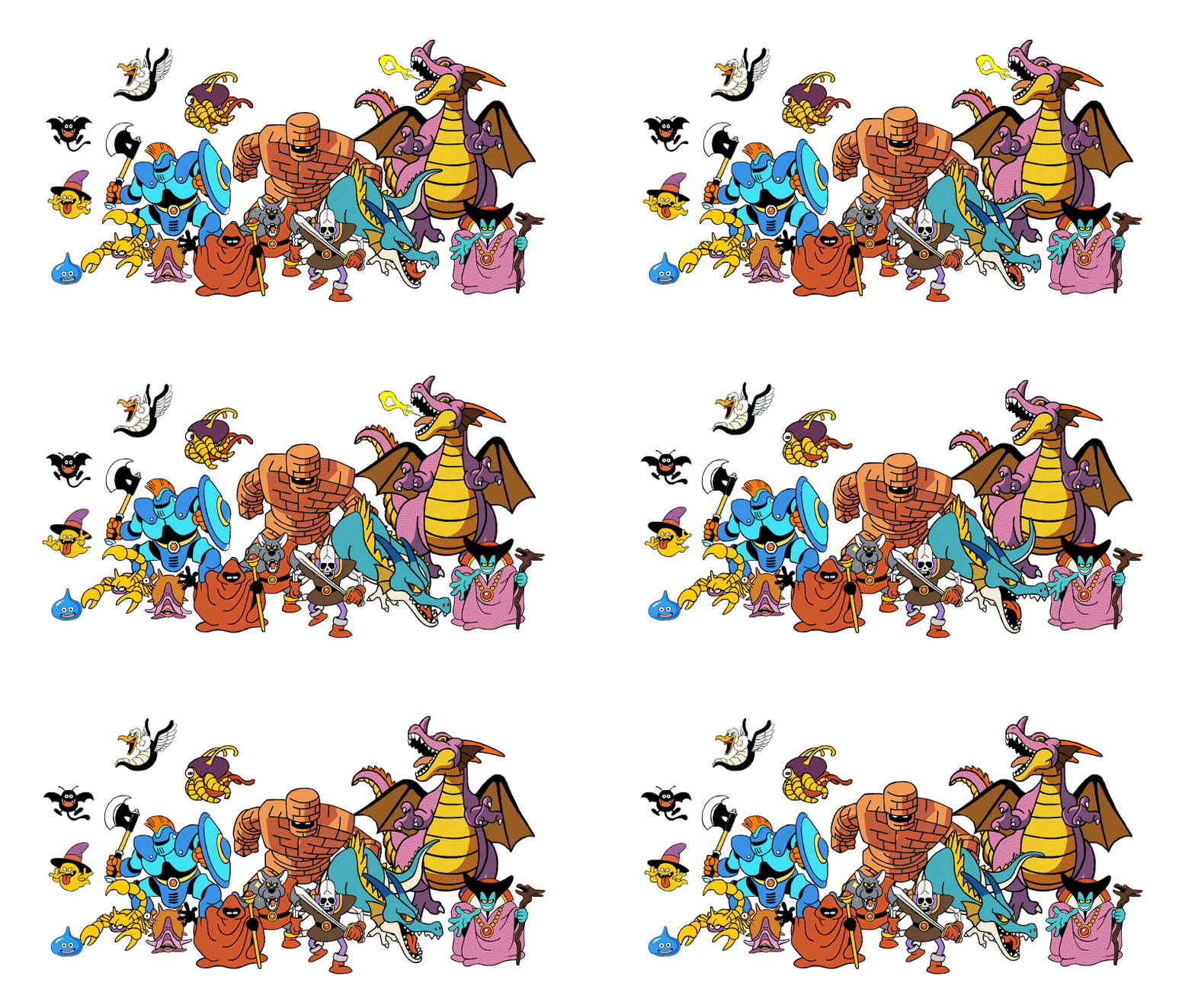 |
| Art by Parker Simmons (@parkerrsimmons) |
The design wasn't the only thing that brought a sense of fun to the fantasy. Dragon Quest games are full of puns and jokes, to a level that Wizardry! never dreamed of. Mercifully, this sense of humour has survived the translation back into English - the team that translates the series have done a fantastic job preserving the nonsense.
A few examples spring to mind - maybe my favourite is Abbot Jack, who runs Alltrades Abbey, a temple in one game where characters can change their Job (Class). Jack of Alltrades, of course, turns out to be host to a terrible demon: the Master of None. Or there are the monster names - they don't have weretigers like in D&D, instead they have weartigers - demons in tiger onesies. The huge mythical sea beast that lives off the coast of a town where everyone speaks in Welsh accents is called Lleviathan.
Dragon Quest is not a comedy series. These are well-crafted and expertly balanced RPG games, and later instalments have some of the most memorable stories and characters in any video game series. The pervasive sense of fun is just what elevates it all to something greater.
The Slime
 |
| The Slime. Look at that lil face! |
Dragon Quest's mascot, as designed by Akira Toriyama, is the Slime. The creature is everywhere in Japan - he has toys, collectables, merchandise, food products, even his own spin-off game series. The only official controller Sony have ever released for the PS4, other than the default Dualshock, is shaped like one of these idiots. Ask a Japanese child... hell, ask any Japanese person to draw "slime", don't even mention Dragon Quest - they'll draw that little dumping-shaped doofus.
The Slime is the first creature you fight in the original Dragon Quest, and serves a similar purpose in every subsequent game. It's a weak, low-level monster that doesn't do much more than get in your way and force you to learn how the battle system works. There are other slime variant that show up later that might present more of a challenge, but this guy is happy where he is: as a weak, pathetic blob of goop with a gormless grin and nothing much else.
He's fun, and that's all he needs to be to be one of the most famous monsters in gaming.
Start Talking About D&D or I'm Out of Here
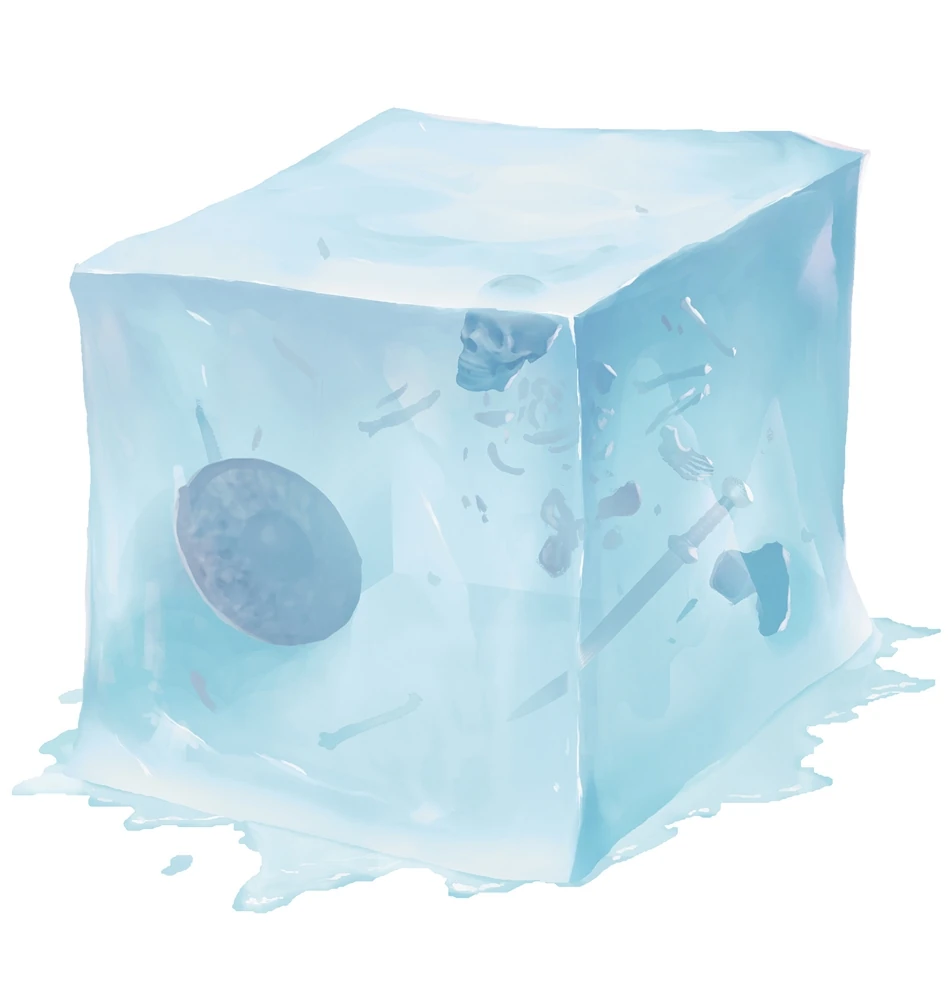 |
| There we go. Familiar territory. |
The Cube, along with the Rust Monster and the Rug of Smothering, come from the Gygaxian School of Fuck You, That's Why. These are creatures specifically designed to trick and trip up players who think that they know everything, or that they're safe, or that they've worked out how to beat the dungeon.
This is... not a fun way to play, for most of us. But it sure did give us some iconic monsters.
Get to the Point
Dragon Quest's monsters are dumb, fun silly cartoons. Toriyama's idea of a Chimera is a fat snake with a goose's head. But they want to kill you.
The Gelatinous Cube - or the Owlbear, or a bunch of other WotC IPs, are stupid. They're weird little beasts imagined up by a man who wanted to fuck his players over so much that he wrote backstory for a bag of knock-off dinosaur toys and used them as minis, so they wouldn't be able to predict what was coming. They're stupid monsters. But they want to kill you.
It doesn't matter how nonsensical the concept is. Try explaining to an Owlbear that it's actually more cute than scary. It's just gonna keep trying to rip your character's face off. You'd better learn how to kill that adorable Slime, or it's going to kill you. The fight is still the same as it would be with any other monster - get rid of their HP, hold on to yours. It's just more fun when you and your friends are all cracking up about the demon in a onesie.
The most bizarre, the most ridiculous, the most laughable parts of your game are probably the best parts. They'll certainly be among the most memorable.
You're all sitting around rolling dice and pretending to be other people. If you can't laugh, what hope is left for you?
Plug Time
 |
| Art by Nicoletta Migaldi |
9 monsters, 4 spells and a playable race - all slime.
It's pay-what-you-want, and you can get it right here.
***
EDIT: A corollary! One thing I didn't mention, lest I began writing an article about Dragon Quest rather than TRPGs, is just how much DQ has influenced the entire fantasy genre in Japan. Mainstream depictions of fantasy in cartoons, comics, films, and especially other games to this day owe a huge debt to Toriyama's work. So, by extension, there's a big D&D flavour in the modern Japanese fantasy genre (because, y'know: D&D >> Wizardry! >> Dragon Quest >> everything after).
That even comes back on itself on occasion. Check this article out, with the official Japanese printing of the Rules Cyclopedia for old-school D&D. See the little hat on the cleric, the whole look of the clothing, the Shoulder Pads? That's straight up Toriyama. Pretty cool!
Subscribe to:
Posts (Atom)