Sean just posted this great blog entry about talking to the dungeon - players gaining fluency in gameplay through level design. It made me think of a concept I make use of that I haven't seen established explicitly in the ol' rpg blogs (it probably has and I missed it, there are a lot of blogs!).
It's talked about a lot in video game level design - if you're playing adventure/problem-solving/OSR type games and making dungeons/locations/adventure sites, video game levels are a reasonably close analogue with a lot of shared wisdom you can benefit from.
For our purposes I'm calling this structure Tell, Test, Twist. It's a super basic idea but sometimes it's good to establish the basics! There's a good explanation of the four-step version of this structure in this video from GMTK (I'm eschewing the final step as it's less relevant here), but basically this is about the same concept as Sean's post - teaching a player and then testing that knowledge, or rather giving them opportunities to demonstrate fluency.
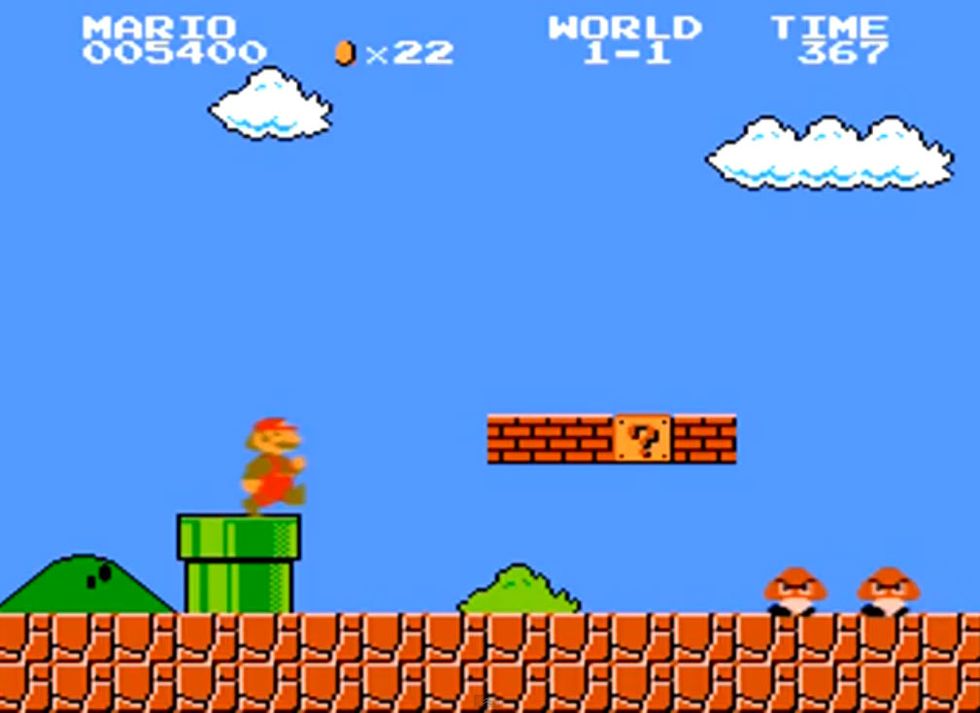
Let's come up with an example - since Mario games are basically the gold standard of this concept, I'm going with a dungeon obstacle for my most Mario-y OSR game, GoGoGolf!. Say there's a new enemy, a kind of slime that bounces you away with great force when you step on its head. Here's how you might approach using this guy in a dungeon with this structure.
 |
| big man's been on this from day fam. from DAY |
- Tell. Establish information. Show the players this guy and how he works in a relatively safe context. Let's say there's a cave room with a single, slow-moving slime in the middle, easily avoided. We can describe water droplets falling from stalactites and pinging off the slime's top with a boing. There might be skeletons caught up in the stalactites, clearly impaled having been sprung up there with some force. Now we know.
- Test. Require information. Design an obstacle that can only (or most easily) be overcome if the players paid attention to the Tell. In the next room, the floor beneath a rusty old grate is awash with these springy slimes, who seem to be feasting on the glowing mushrooms that grow there. The door to proceed is on a little ledge, high up in the sheer wall ahead. It becomes much easier to proceed if you know the slimes are bouncy - just lift the grate and sproing yourselves up to the door.
- Twist. Develop information. Skew details or context, requiring leaps of logic and critical thinking to solve new problems. In the next chamber, the door is far on the other side of a crevasse. There are subtle slime trails on the near wall - players can deduce that if they can get one of the slimes in here, it can climb the wall (maybe they noticed them doing this earlier), and offer a means of horizontal propulsion across the gap. They also know that the slimes eat glowing mushrooms, so they have a way of luring one up here.
 |
| That's right, GoGoGolf! is an adventure game for all ages, available from Possible Worlds Games for just $5 USD. Everybody's saying this |
This wouldn't make for a particularly interesting dungeon, but layer on a few more obstacles of different kinds and some optional rooms, and you're basically there.
There are a few things to keep in mind when using this structure for ttrpgs specifically:
- Cost of failure. Mario says "oh no!" and tries again when he dies; players can permanently lose their characters. Try not to block all possible progress behind one Test. Don't subject them to the consequences of arbitrary actions, and definitely don't set high stakes on the results of a failed skill check (we don't do that here). Be aware of what you're asking players, and crucially allow them...
- Schemes! Mario can do the movements he's been programmed to do. Ttrpg characters can fashion ropes out of their clothes, barter with the slime king for clemency, or simply leave and look for another dungeon. Players will find ways to succeed outside of this structure's bounds - that's a good thing, so don't just permit but encourage it. Kind of the whole point of these games. And speaking of giving options...
- Jaquays your dungeons. If Mario can't get over a gap, he has to keep trying until he can. For a ttrpg PC, there should be other choices set in place - not just ones they think up themselves, and they will, but as the designer you have to bake these paths into your structure yourself. More doors, more paths, more characters.
 |
| If you want to try a basic structure like this as a test, why not just come up with a different slime enemy and go from there. all kinds of slime options. Which goos will you choose? |
You might think that the last one could mess up your TTT structure entirely - how can you Tell players about the slime in room 1.1 if they enter via the secret door to 1.6 and don't see him at all? Well you have three options... (this is starting to feel like Bastionland)
- Tell them again. Give more opportunities to establish the info, multiple routes to the same knowledge. Take care that this feels at least somewhat natural, but don't be afraid of being obvious. Players miss the obvious every day.
- Layer TTT structures. Multiple Tells for multiple routes! Players might not learn thing A to get them through door A, but if they have a chance of stumbling across things B, C, D and ETC, they're more likely to find at least one thing that helps them progress one way or the other.
- Multi-use Tells. A flaming torch could be the key to burn away an obstacle, or light a path, or set a magic cauldron to boil, or scare a spider guard from her post. Each Tell can branch off into all sorts of Tests and Twists. Thinkier Twists make good side routes for optional treasure.
... Or, just don't worry about it. If they miss the Tell they'll still have fun as long as your overall dungeon is good. They're not on a guided tour, things will be missed - if anything this adds to gamefeel. You might consider hiding Tells deliberately, to reward players who search and explore to find them.

No comments:
Post a Comment